How to find a druggable target: A computational perspective

JUN 25, 2025

How to find a druggable target: A computational perspective

Roughly 20,000 proteins make up the human proteome, yet not all proteins are suitable drug targets. This makes finding druggable targets a critical early step in drug discovery. Structure-based techniques can enable better, quicker, and more cost effective target tractability assessment. These technologies can also expedite hit discovery and ligand binding potency and selectivity optimization and guide medicinal chemistry rationale.

Join us in this beginner-friendly webinar that will introduce you to strategies and best-in-class tools for identifying druggable, technology-enabled targets. We will review workflows to assess protein binding sites and identify protein-ligand complexes suitable for structure-based drug design. We will also discuss how to reduce uncertainty in structure-based drug models using free energy methods (FEP+), as well as examine how modern physics-based modeling approaches amplified by machine learning can reveal new therapeutic opportunities.

Last, we will highlight a real-world case study from Schrödinger’s Therapeutics Group, showcasing how these strategies were used to assess the druggability of the Wee1 binding site and subsequently how FEP+ was used to enable the discovery of a highly selective Wee1 inhibitor for the treatment of solid tumors. The case study demonstrates the power of computational approaches to unlock challenging targets and drive successful drug discovery programs.

Whether you’re new to modeling or looking to expand your toolkit, this session will provide a practical foundation and a comprehensive guide to help you get started.

Webinar highlights:

  • Discussion of what a computationally druggable target is and how to identify one
  • Overview of structure-based techniques, including docking, molecular dynamics, and free energy methods
  • Introduction to integrated tools and workflows for binding site detection, druggability assessment, and target prioritization
  • Leveraging FEP+ to validate structural models and reduce uncertainty by comparing predicted and experimental ligand affinities
  • Case study: Applying these approaches in Schrödinger’s Wee1 inhibitor discovery program

Our Speaker

Fiona McRobb

Senior Principal Scientist, Computational Chemistry, Therapeutics Group, Schrödinger

Fiona McRobb received her Ph.D. in Medicinal Chemistry from Monash University in Australia in 2012. Her Ph.D. encompassed both synthetic and computational approaches to study G protein-coupled receptors (GPCRs). In 2011, she joined Prof. Ruben Abagyan’s lab at UCSD as a postdoc, studying allosteric modulators of GPCRs and environmental toxicology. Fiona joined Schrödinger in 2014 as an Applications Scientist before transitioning to Schrödinger’s Therapeutics Group in 2016. As a Senior Principal Scientist, she applies Schrödinger’s computational chemistry software to address challenging problems in drug discovery, with a focus on identifying new targets and early drug discovery programs.

Digital and AI-Driven Materials Innovation

Symposium

Digital and AI-Driven Materials Innovation

CalendarDate & Time
  • July 8th, 2025
LocationLocation
  • Hong Kong

We hope you can join us at the Hong Kong University of Science and Technology (HKUST) on July 8th for the Digital and AI-Driven Materials Innovation symposium.

Co-organized by the Office of Knowledge Transfer and the Department of Chemistry, this premier industry-academic forum brings together leading experts, pioneering technologists, and academic innovators to explore how artificial intelligence is transforming materials science.

Attendees will:

  • Gain insights into how AI and computational tools are transforming materials discovery, from atomic-scale simulations to industrial applications
  • Learn from leading experts across academia and industry, including speakers from industry, R&D centers and academics
  • Explore real-world case studies on AI-enabled innovations in semiconductors, OLEDs, specialty polymers, and pharmaceutical formulations
  • Engage in discussions on the future of materials informatics, high-throughput screening, and machine-learned force fields
  • Network with scientists, engineers, and innovators driving the next wave of digital and AI-driven materials research

Through keynote presentations, technical talks, and a panel discussion, participants will gain actionable insights into how AI is accelerating materials innovation across sectors—from lab discovery to commercial impact.

icon time 09:30 – 10:00
Guest Registration

HKUST Clear Water Bay Campus

icon time 10:00 – 10:05
Welcome Remarks

Speaker: Prof. Tim Cheng, VPRD, HKUST

icon time 10:05 – 10:10
Opening Remarks

Speaker: Prof. Jianzhen Yu, Head and Chair Professor, Department of Chemistry, HKUST

icon time 10:10 – 10:15
Opening Remarks

Speaker: Dr. Michael Rauch, Associate Director of Materials Science, Schrödinger

icon time 10:15 – 10:20

Session Chair: Zhenyang Lin, HKUST

icon time 10:20 – 10:40
Physics-Enabled AI for Next-Generation Materials Discovery: Bridging Atomic-Scale Simulation and Machine Learning with Schrödinger

Speaker: Dr. Michael Rauch, Associate Director of Materials Science, Schrödinger

icon time 10:40 – 11:10
Materials Design in Electronics Industry: Application of Materials Informatics and High-Throughput Calculations

Speaker: Dr. Nobuyuki N. Matsuzawa, Director, Panasonic Corporation

icon time 11:10 – 11:30
Designing Tomorrow’s Materials: The Role of AI in Exchange-Correlation Functional

Speaker: Prof. Guanhua Chen, Chair Professor, Department of Chemistry, The University of Hong Kong

icon time 11:30 – 2:00
Lunch

Session Chair: Kevin Chen, HKUST

icon time 2:00 – 2:20
AI in Semiconductor Industry

Speaker: Dr. Ziyang Gao, Senior director, Hong Kong Microelectronics Research and Development Institute

icon time 2:20 – 2:40
Simulations of Atomic Level Processing with Examples from Metal ALD

Speaker: Dr. Simon Elliott, Senior Research Leader, Schrödinger

icon time 2:40 – 3:00
AI-Enabled OLED Materials Discovery

Speaker: Dr. Wei Xu, Research scientist, TCL AI Lab

icon time 3:00 – 3:20
Coffee break

Session Chair: Ping Gao, HKUST

icon time 3:20 – 3:40
AI-Guided Interfacial Engineering for Rational Design of Polymeric Microcapsules

Speaker: Prof. Jinglei Yang, Professor, Department of Mechanical and Aerospace Engineering, HKUST

icon time 3:40 – 4:00
Advancing Specialty Polymer Innovation Using Molecular Simulation and Machine Learning

Speaker: Dr. Atif Afzal, Principal Scientist, Schrödinger

icon time 4:00 – 4:20
Accelerating Pharmaceutical Formulations using the Schrödinger Software Suite

Speaker: Dr. Sudharsan Pandiyan, Principal Scientist, Schrödinger

icon time 4:20 – 5:00
Panel discussion / Closing remarks

Our Speakers

Tim Cheng

Professor, VPRD, HKUST

Jianzhen Yu

Professor, Chem, HKUST

Dr. Michael Rauch

Associate Director of Materials Science, Schrödinger

Dr. Nobuyuki N. Matsuzawa

Director, Panasonic Corporation

Dr. Ziyang Gao

Senior Director, Hong Kong Microelectronics Research and Development Institute

Dr. Wei Xu

Research Scientist, TCL AI Lab

Guanhua Chen

Professor, The University of Hong Kong

Dr. Simon Elliott

Senior Research Leader, Schrödinger

Dr. Atif Afzal

Principal Scientist, Schrödinger

Dr. Sudharsan Pandiyan

Principal Scientist, Schrödinger

Jinglei Yang

Professor, HKUST

CRS 2025

Conference

CRS 2025

CalendarDate & Time
  • July 14th-18th, 2025
LocationLocation
  • Philadelphia, Pennsylvania

Schrödinger is excited to be participating in the CRS Annual Meeting 2025 taking place on July 14th – 18th in Philadelphia, Pennsylvania. Join us for a presentation by Schrödinger’s John Shelley and David Nicholson, titled “Molecular modeling and machine learning for drug formulation.” Stop by booth #302 to speak with Schrödinger scientists.

icon time JUL 15 | 9:00AM – 10:00AM
Molecular modeling and machine learning for drug formulation

Speakers:
John Shelley, Fellow, Schrödinger
David Nicholson, Principal Scientist I, MS Applications Scientist, Schrödinger

Abstract:
Schrödinger, a leader in the application of structure-based molecular modeling and machine learning to drug discovery and development, will provide a brief, broad overview on the emerging field of structure-based molecular modeling for drug formulation followed by two more focused presentations: 1. Modeling the formation, structure and behavior of mRNA-containing lipid nanoparticles and 2. Excipient/polymer selection for small-molecule drug formulation including amorphous solid dispersions. We anticipate that attendees will gain an understanding of:
The value and limitations of structure-based molecular modelling and machine learning for drug formulation
Employing modeling to impact excipient selection
How molecular modeling, particularly when combined with experiment, can lead to a competitive advantage by providing insight into complex formulations

Crystal Structure Prediction

Crystal Structure Prediction

Crystal Structure Prediction

De-risk your solid form selection process by identifying the most stable polymorph at room temperature

Stability ranking of crystal polymorphs

Overcome the risks associated with disappearing polymorphs in late stage drug development. Schrödinger’s proprietary crystal structure prediction platform identifies the stable crystal polymorphs at 0K and RT for a given active pharmaceutical ingredient (API).

Key Capabilities

Fast and comprehensive identification of polymorphs at room temperature and beyond

  • Novel, systematic approach allows exhaustive yet efficient sampling of crystal packings 
  • High throughput workflow with fast turnaround time

High accuracy validated on extensive dataset of challenging, diverse drug-like molecules

  • Retrospective validation on a set of 65 drug-like molecules with accuracy close to 100% in predicting the most stable solid form
  • Prospective validation confirmed accuracy and reliability

Crystal Structure Prediction Workflow

Schrödinger solutions for physicochemical property prediction

Optionally predict key properties of an API to support selection of a stable solid form.

Crystalline solubility of polymorphs using free energy methods with FEP+
Learn more
ssNMR chemical shifts to support crystallization experiments with Quantum ESPRESSO
Learn more
Crystal habits (morphology) to support downstream processing with MS Morph
Learn more
Mechanical properties (Young’s and shear modulus) to complement direct compaction and milling experiments with MD engine Desmond

Learn more
Featured Service

Crystal Structure Prediction Services

Work with our team of computational experts to de-risk your solid form selection process. Starting from a 2D structure of the API, Schrödinger’s team will deliver to you the thermodynamic stability ranking of crystal polymorphs.

Publications

Browse the list of peer-reviewed publications using Schrödinger technology in related application areas.

A robust crystal structure prediction method to support small molecule drug development with large scale validation and blind study

Zhou D, et al. Nature Communications, 2025, 16, 2210

Free energy perturbation approach for accurate crystalline aqueous solubility predictions

Hong RS, et al. J. Med. Chem. 2023, 66, 23, 15883-15893

Novel physics-based ensemble modeling approach that utilizes 3D molecular conformation and packing to access aqueous thermodynamic solubility: A case study of orally available bromodomain and extraterminal domain inhibitor lead optimization series

Hong RS, et al. J. Chem. Inf. Model. 2021, 61, 3, 1412-1426

Related Products

Learn more about the related computational technologies available to progress your research projects.

MS Maestro

Complete modeling environment for your materials discovery

FEP+

High-performance free energy calculations for drug discovery

Desmond

High-performance molecular dynamics (MD) engine providing high scalability, throughput, and scientific accuracy

Quantum ESPRESSO Interface

Integrated graphical user interface for nanoscale quantum mechanical simulations

MS Morph

Efficient modeling tool for organic crystal habit prediction

OPLS4 & OPLS5 Force Field

A modern, comprehensive force field for accurate molecular simulations

Software and services to meet your organizational needs

Software Platform

Deploy digital materials discovery workflows with a comprehensive and user-friendly platform grounded in physics-based molecular modeling, machine learning, and team collaboration.

Research Services

Leverage Schrödinger’s expert computational scientists to assist at key stages in your materials discovery and development process.

Support & Training

Access expert support, educational materials, and training resources designed for both novice and experienced users.

Lunch & Learn: Accelerating molecular discovery using an in silico design platform

Lunch and Learn

Accelerating molecular discovery using an in silico design platform

CalendarDate & Time
  • June 27th, 2025
  • 10:00 to 16:00 CET
LocationLocation
  • Basel, Switzerland
Register

Take a break from your other obligations and let’s talk! We are inviting you to join us on Friday, June 27th at the Hotel Essential by Dorint Basel City for an extended version of our Lunch and Learn series where we will introduce the diverse capabilities of Schrödinger’s molecular design platform. Schrödinger scientists will present how modern physics-based simulation methods as well as machine learning can help to create better molecules faster and answer your questions around computer-driven molecular design.

Date & Time:

Friday, June 27, 2025

From 10:00 AM to 16:00 PM CET

Program:

Part 1: Small Molecule

10:00 – 12:00

Accelerating small molecule drug discovery combining physics-based methods, machine learning techniques, and digital chemistry

David Rinaldo, Senior Principal Scientist, Applications Science

Drug design is a highly complex task literally consisting in finding a molecule with defined properties in the ocean of all possible molecules. In the past 10 years the field has experienced dramatic changes including an explosion in the size of commercial chemical libraries, a significant increase in available computing power (GPU, cloud computing), and significant advances in machine learning techniques. In this workshop, we will see how Schrödinger has been leveraging those technological revolutions to accelerate the small molecule drug discovery process.

First, we will present a few physics-based methods that Schrödinger has been recently developing and then we will see how those techniques can be combined to efficiently and collaboratively find new drug candidates.

+ Lunch

Part 2: Biologics

13:00 – 16:00

Accelerating biologics design through computational modelling and collaborative enterprise informatics

Dan Cannon, Principal Scientist II, Applications Science

Jelena Vucinic, Senior Scientist I, Applications Science

This Schrödinger workshop will explore how to use physics-based computational methods (BioLuminate, FEP+) and collaborative enterprise informatics (LiveDesign) to accelerate biologics design. We will present case studies on large-scale mutagenesis for affinity, analyzing and correcting developability issues, variant selection based on cross-reactivity, multi-parameter ideation, and more. Whether you’re new to computational tools or looking for a deeper dive into advanced methods, this session is designed to provide valuable insights for all experience levels.

+ Coffee and Cake

Location:

Hotel Essential by Dorint Basel City
Schönaustrasse 10, CH-4058 Basel
Click here to view map of room location.

Register

Accelerating chemical innovation with AI/ML: Breakthroughs across materials applications

JUN 17, 2025

Accelerating chemical innovation with AI/ML: Breakthroughs across materials applications

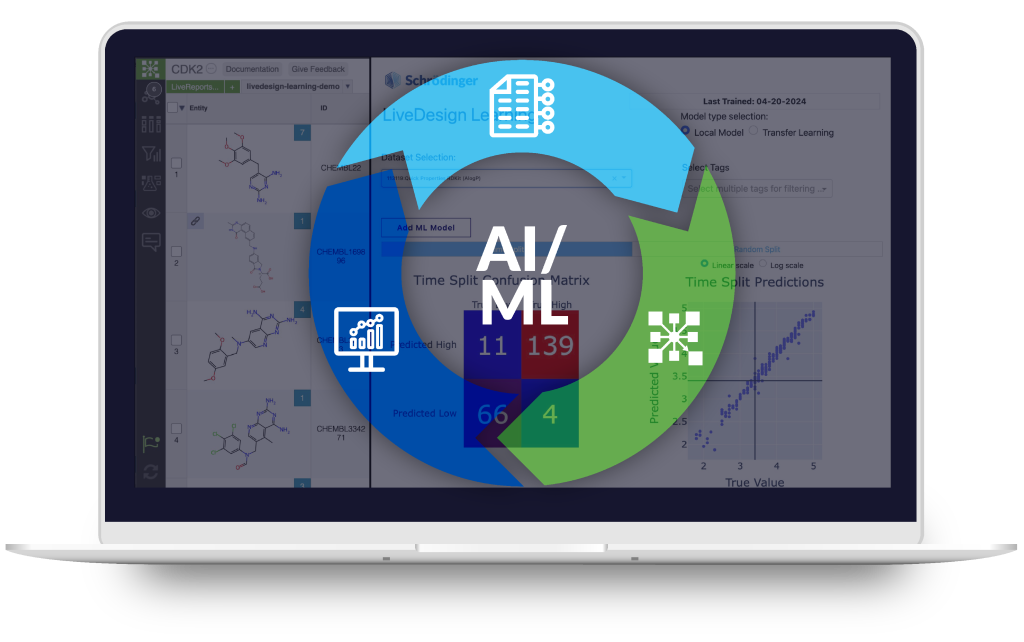
Artificial intelligence (AI) and machine learning (ML) are transforming materials science, unlocking new possibilities for innovation by enabling data-driven design and optimization across a wide range of applications. From accelerating the discovery of novel materials to optimizing formulations for specific performance criteria, AI/ML allows researchers to explore complex chemical spaces with unprecedented speed and precision. These approaches reduce reliance on trial-and-error experimentation, even in data-limited environments; empowering scientists to tackle challenges across diverse technology domains, including electronics, energy storage, polymers, and catalysis. Schrödinger’s integrated platform, which combines chemistry-informed ML with physics-based simulations, enhances predictability, scalability, and overall innovation in materials design.

In this webinar, we will explore how AI/ML is driving impactful advancements in materials innovation, highlighting case studies that illustrate cutting-edge ML techniques in diverse applications. Additionally, we will introduce the Schrödinger platform, illustrating how it empowers researchers to efficiently design and optimize materials. Specifically, we will highlight:

  • Design of novel OLED devices with physics-augmented machine learning
  • Optimization of materials properties for consumer packaged goods, battery electrolytes, polymers, and catalysis
  • Utilization of machine learning force fields (MLFF) for enhanced throughput and precision of atomistic simulations

Our Speaker

Anand Chandrasekaran

Senior Principal Scientist, Schrödinger

Anand Chandrasekaran joined Schrödinger in 2019 and currently serves as the Product Manager for MS Informatics. His expertise lies in applying machine learning across various domains within materials science and computational modeling. He earned his Ph.D. in Materials Science under Prof. Nicola Marzari at the Swiss Federal Institute of Technology, Lausanne. Prior to joining Schrödinger, Anand worked with Prof. Rampi Ramprasad, focusing on polymer informatics, machine learning force fields, and machine learning for electronic structure calculations.

Schrödinger User Group Meeting – Materials Science Japan 2025 Part 3

User Group Meeting
CalendarDate & Time
  • July 23rd, 2025
LocationLocation
  • Tokyo, Japan

Schrödinger User Group Meeting – Materials Science Japan 2025 Part 3

Formulation and Cosmeticsをテーマに、弊社サイエンティストや各製品の開発責任者から、最新機能、応用事例、今後の展望などを、セミナー形式でご紹介いたします。

発表要旨はこちらからご覧いただけます。

icon time 10:00-10:10
ご挨拶

icon time 10:10-11:10
計算を用いた医薬品開発における原薬形態開発の実例

小野薬品工業株式会社 製剤研究部 サイエンティフィックアドバイザー 真野 高司様

icon time 11:10-11:55
Advancing Materials Science with Schrödinger: Latest Innovations, Future Roadmap, and Key Applications Impacting Personal Care, Foods and Fragrances, and Pharmaceutical Formulations

Mathew D. Halls, Senior Vice President, Materials Science

icon time 12:55-13:40
Schrödinger’s Modeling Platform and Solutions to Accelerate Drug Substance and Drug Product Formulation and Delivery Processes

Shiva Sekharan, Senior Director of Formulations Business Development & CSP Software

icon time 13:40-14:25
Schrödinger Reactivity and Catalysis Tools for Pharma Formulation and Cosmetics

Pavel A. Dub, Product Manager Catalysis and Reactivity

icon time 14:25-15:10
Combined Physics-Based and Machine Learning Approaches in the Design of Complex Formulations

Anand Chandrasekaran, Senior Principal Scientist

icon time 15:40-16:25
Enabling Formulation via Coarse-Grained Modeling: Application to Proteins Solutions and LNPs

John C. Shelley, Fellow

icon time 16:25-17:10
Transforming Cosmetic Innovation with Physics-Based Modeling and AI

Jeffrey M. Sanders, Product Manager and Scientific Lead of Consumer Goods

icon time 17:10 – 17:20
クロージング

icon time 17:30 –
懇親会

【開催形式と会場】
・現地開催です。オンライン配信はございません。
会場
トラストシティ カンファレンス・丸の内
〒100-0005 東京都千代田区丸の内1-8-1 丸の内トラストタワーN館11階

※登録受付は7月15日(火)23:59までといたします。
※会場の収容可能人数には限りがあり、登録受付期日前であっても、上限に達し次第締め切りとなります。お早めにお申し込みください。
※参加者様へは、別途メールにて詳細をご案内いたします。

【参加費】
無料

【お申込みにあたって】
所属企業または所属機関のメールアドレスにて、登録をお願いします。
フリーメールや個⼈メールアドレスでご登録の場合などは、出席をご遠慮いただく場合がございます。
同業他社さまには参加をご遠慮頂いております。ご理解のほど宜しくお願い致します。

※ご質問、ご不明な点がございましたら下記までお問い合わせください。
シュレーディンガー株式会社 UGM3事務局
E-mail: info-japan@schrodinger.com

Schrödinger Polymer Workshop 2025

Workshop

Schrödinger Polymer Workshop 2025

CalendarDate & Time
  • May 21st, 2025
LocationLocation
  • Mannheim, Germany
Register

Using Schrödinger’s Materials Science Suite for atomic-scale simulations

Schrödinger invites you to a one-day in-person workshop in Mannheim, Germany to gain hands-on experience with Schrödinger software for polymer design and simulation for a variety of applications.

Participants will get practical experience and in-person guidance in using our Materials Science Suite and the tools involved in building molecules, polymers, and complex mixtures for use in molecular dynamics simulations. Leveraging automated property prediction workflows as well as analysis tools will play an important role. Another aspect will be the application of machine learning.

Examples of how molecular-scale simulations can inform polymer and polymer formulation development will be included throughout the day.

Full agenda TBD

When & Where:

Wednesday 21st May 2025

Glücksteinallee 25
68163 Mannheim
Germany
(5 minutes walk from Mannheim Hauptbahnhof)

Please see our  page for information regarding what to bring, getting to the venue, and accessibility.

If you need further information please contact Patrick Heasman: patrick.heasman@schrodinger.com

If you are interested but unable to attend in person, please reach out to the contact above.

Registration:

Registration is free and includes lunch and refreshments.

Participants must bring their own laptop to access the software, and an external mouse is recommended. We will be utilising our Virtual Computer, which is accessed via web browser – No software installation is required prior to the session.

Places are limited, so please ensure to register as soon as possible.

Registration will close at latest on Friday 16th May 2025.

Who should attend:

Any researcher studying polymer design, polymer application, or generally interested in learning about computational materials science. No prior experience is required.

Instructional material can be reviewed before or after the workshop for free on our website:


Speakers and demonstrators:

  • Dr. Caroline Krauter
  • Dr. Irene Bechis
  • Dr. Patrick Heasman

Agenda

Register

FAQs

How long is the workshop?

The workshop is an all day event to give you the best opportunity to learn about our tools and benefit from the practical sessions throughout. We will start at 10:00 am and finish at approximately 4:00 pm.

Where is the venue and how can I get there?

The workshop is being help at our offices in Mannheim, Germany. The building is accessible via car, and the train station is within a 5 minute walk.

What is included with my registration?

Registration is completely free to attend the workshop. We will also be providing food and refreshments throughout the day.

Can I join the session virtually / remotely?

As we want to give the attendees help and guidance during the workshop we currently have no intention of running this workshop online. Please reach out if you are interested but are unable to travel to the event location.

Please contact Patrick Heasman (patrick.heasman@schrodinger.com) for any additional information about the event and the location.

Travel:

  • Via plane / train:
    Frankfurt / Frankfurt Airport – A direct train to Mannheim takes approximately 45 minutes.
  • Via car:
    There are several car parks located on Glücksteinallee.

Hotel recommendations:

  • Holiday Inn Mannheim City
  • LanzCarré Hotel Mannheim
  • Premier Inn Mannheim City Centre hotel
  • Hilton Garden Inn Mannheim

What do I need to bring?

A laptop is required for this workshop. We will not be providing any on the day, so please ensure that you bring one. We also recommend that you bring a personal laptop to avoid any firewall restrictions.

An external mouse is not required, but we do recommend that you bring one as our software makes full use of the 3 buttons.

Do I need to download and install the software prior to the event?

No. We will be utilising the Schrödinger Virtual Computer for all hands-on sessions. A suitable web browser is required for accessing this (Chrome, Edge, Firefox).

Release 2025-2

Library Background

Release Notes

Release 2025-2

Small Molecule Drug Discovery

Platform Environment

Maestro Graphical Interface

  • New Welcome Screen on startup provides quick access to common tasks such as creating and opening projects and importing structures
  • Modernized and streamlined Project Table for enhanced usability
    • New Table Configuration pane allows fast switching between Light and Dark themes and toggles visibility of the ePlayer and Property Tree.
    • New Gadgets Menu provides convenient access to Charts and the 2D Viewer
  • New Workflow Action Menu (WAM) to view spectroscopy results from Jaguar and Jaguar Spectroscopy calculations in the Project Table

Target Validation & Structure Enablement

Protein Preparation

  • Improved minimization protocol to support broader coverage of biological and chemical systems
  • Produce more reliable prepared structures by expanded coverage of equivalent tautomeric ligand states
  • More easily view serious structural issues by filtering diagnostic reports with a severity threshold
  • New ‘Missing Atom’ tab on the Diagnostics panel enables select sidechain and loop modeling

Cryo-EM Model Refinement

  • GlideEM poses are now sorted by GlideScore which is more discriminating in ranking low RMSD structures than Denscore

Ligand Preparation

Ligand Docking

  • Faster Glide scoring and docking with optimized Glide (Beta): Screen larger libraries and find better candidates with optimized Glide, including enhanced Active Learning Glide and Python API support
    • Same industry-leading Glide docking funnel and scoring functions, Emodel and GlideScore
    • Faster turnaround with same compute resources for Active Learning Glide and AutoDesigner
    • Advanced Python API support offers easy automation and file control over docking process for greater experimentation
    • Accessible through the new Ligand Docking panel that enables setup of Active Learning and Glide calculations

ABFEP

  • Energy Decomposition data is now reported in Analysis PDF reports

Lead Optimization

FEP+

  • New FEP+ Pose Builder workflow for automatically generating high-quality ligand alignments (Beta): Generate FEP-ready poses faster and run FEP+ at scale with an automated workflow designed for unbiased selection and robust atom-mapping
  • Ability to read and write FEP+ Protocol files directly in the FEP+ Panel
  • Improved Classification matrix styling
  • Kendall’s tau statistic added to the statistical metrics reported
  • Improvements to exported FEP+ data in csv/xls formats
  • Added ‘None’ as a new Hot Atom Rule

Protein FEP

  • FEP+ Residue Scan supported in Protein FEP+ for Ligand Selectivity panel

Constant pH Simulations

  • Added support for Cysteine residues

FEP+ Protocol Builder

  • Sharply reduced compute resources to run default workflow by shrinking initial simulation times to 0.5 ns and extended times to 10 ns
  • Seamless interconnection as FEP+ Panel can now Read/Write Protocol Builder files
  • Bias the selection of protocols to extend including compute efficiency via Pareto analysis (command line only)
  • Added support for covalently bound ligands
  • Ability to optionally sample charge states of GLU, ASP, LYS, ARG, and CYS in protocol optimization

De Novo Design

AutoDesigner – R-group Design

  • New R-group Similarity score feature to focus ideation around compounds of interest
  • New Design Rationale capability to improve ADME endpoints with respect to reference ligands

Alternative Modalities

Bifunctional Degraders

  • Expanded support for protein degrader modeling with the new Degrader Sampling Workflow (Beta): Generate accurate degrader ternary complexes through integration of protein-protein docking and linker sampling in a structure-based workflow

Biologics Drug Discovery

  • Augmented AI/ML capabilities for biologics with machine learning-based T-Cell Receptor (TCR) structure prediction (Beta): Perform high throughput structure prediction and large scale modeling of TCRs with the ImmuneBuilder deep learning model and Prime
  • New Macromolecular Pose Filtering panel to filter native or near native poses from an ensemble of complexes using experimental data such as HDX-MS

Materials Science

GUI for Quantum ESPRESSO

Product: Quantum ESPRESSO (QE) Interface

  • A new environment variable for the location of Quantum ESPRESSO binary

Transport Calculations via MD simulations

Product: MS Transport

  • Thin Plane Shear: Selection of slab region by molecular units

KMC Charge Mobility

Product: MS Mobility

  • Compute KMC Charge Mobility: Predictions based on Schrödinger’s new mobility engine

Materials Informatics

Product: MS Informatics

  • Machine Learning Property: Updates to existing models
  • Machine Learning Property: Prediction of triplet reorganization energy
  • Machine Learning Property: Prediction of S1-to-T1 energy gap (∆EST)
  • Machine Learning Property: Predictions from the interactive mode automatically added to the Project Table
  • MLFF Calculations (Beta): Single-point energy and geometry optimization tool using Schrödinger’s latest machine-learned force fields

Formulation ML

Product: MS Formulation ML

  • Formulation ML: Support for custom ingredient descriptors
  • Formulation ML: Support for creating models using multiple CPUs in parallel
  • Formulation ML: Support for setting mixtures as individual components
  • Formulation ML Optimization: Workflow solution to optimize materials formulations

Layered Device ML

Product: MS Layered Device ML

  • OLED Device ML: Workflow solution to predict OLED device performance
  • Optoelectronic Device Designer: Use ML OLED device models to predict performance

Coarse-Grained (CG) Molecular Dynamics

Product: MS CG

  • Automated CG Mapping: (+AUTOMAPPING_MARTINI_PROTEIN) Support for proteins in automated mapping and parameterization for Martini
  • Automated CG Mapping: Accurate mapping for carbohydrate systems
  • Improved threshold for momentum errors in CGMD simulations
  • CG FF Builder: Parameters for water-water interactions fixed by default

Dielectric properties

Product: MS Dielectric

  • Complex Permittivity: Option to run replicates in parallel

Reactivity

Product: MS Reactivity

  • Reaction Network category created under the Materials task menu
  • Reaction Workflow renamed to Reaction Network Profiler
  • Auto Reaction Workflow renamed to Reaction Network Enumeration Profiler
  • Reaction Network Profiler: Option to run conformational search using CREST
  • Reaction Network Profiler: Conformational search included in restarts (command line)
  • Nanoreactor: Option to screen products by energy relative to reactant state
  • Nanoreactor: (+ELEMENTARY_REACTION_NETWORK) Support for the Elementary Reaction Network workflow

Microkinetics

Product: MS Microkinetics

  • Microkinetics Deposition Analysis: Workflow solution to run post-analysis of microkinetic simulations in deposition or etch processes of solid materials
  • Microkinetic Modeling: (+MATSCI_MKM_INTERACTIONS) Support for simple quadratic adsorbate-adsorbate interactions

Reactive Interface Simulator

Product: MS RIS

  • Solid Electrolyte Interphase: Option to block intramolecular reactions (command line)
  • Solid Electrolyte Interphase: Option to use DFT charges for new species

Crystal Structure Prediction

Product: Crystal Structure Prediction

  • Crystal Structure Prediction: Interface and workflow to predict crystal structures and polymorphs for a given molecular compound

MS Surface

Product: MS SurfChem

  • Adsorption Enumeration: Access to workflow assessing reactive adsorption
  • Desorption Enumeration: Workflow solution for assessing desorption of multiple molecules

MS Maestro User Interface

  • Direct link from the task menus to Materials Science Panel Explorer page

MS Maestro Builders and Tools

  • Structured Liquid: Automatic standardization of custom lipids
  • Polymer: Improved dihedral setups for multiple shortest-length backbones
  • Organometallic Conformational Search: Option to run conformational search using CREST

Classical Mechanics

  • Evaporation: Option to export the results as CSV file
  • MD Multistage: Center of mass motion removed for coarse-grained systems
  • Thermophysical Properties: Option to save trajectory energy file
  • Umbrella Sampling (Beta): Workflow solution for umbrella sampling of membranes

Quantum Mechanics

  • Adsorption Energy: Support for reactive adsorption and desorption energies
  • Adsorption Energy: Improved assessment of entropy loss during the adsorption
  • Bond and Ligand Dissociation: Option to set product charges from formal atomic charges
  • Bond and Ligand Dissociation: Support for PCM and SMD solvent models
  • Bond and Ligand Dissociation: Improved 2D visualization of charges and radicals in product fragments
  • Crest: UI for semiempirical QM based conformational search using CREST
  • Optoelectronic Film Properties: Support for multiple reorganization energies as input for computing intersystem crossing (ISC) rate
  • Optoelectronic Film Properties Viewer: Support for user-input reorganization energies to instantly re-evaluate SEET rate
  • Thermochemistry Viewer: Support for viewing reactive adsorption and desorption energies
  • Trajectory Density Analysis: Improved naming scheme for atom groups

Education Content

Life Science

  • New tutorial: Exploring Protein Binding Sites with Mixed-Solvent Molecular Dynamics
  • New tutorial: Introduction to T-Cell Receptor Modeling with BioLuminate
  • Updated tutorial: Antibody Visualization and Modeling in BioLuminate
  • Updated tutorial: Peptide Modeling with BioLuminate
  • Updated tutorial: Target Analysis with SiteMap and WaterMap
  • New QRS: Structure Reliability Report
  • New QRS: Custom Reactions for Covalent Docking
  • New QRS: Mixed-Solvent Molecular Dynamics
  • Updated QRS: GlideWS Model Generation
  • Updated QRS: MM-GBSA Residue Scanning

Materials Science

  • New Tutorial: Umbrella Sampling
  • New Tutorial: Crystal Structure Prediction
  • New Tutorial: Optimization of Formulations Using Machine Learning
  • New Tutorial: Machine Learning for OLED Device Design
  • New Tutorial: Nanoemulsions with Automated DPD Parameterization
  • New Tutorial: Applied Machine Learning for Formulations
  • Updated Tutorial: Atomic Layer Deposition
  • Updated Tutorial: Design of Asymmetric Catalysts with Reaction Network Enumeration Profiler (previously AutoRXNWF)
  • Updated Tutorial: Machine Learning Property Prediction
  • New QRS: CREST
  • New QRS: Microkinetics Deposition Analysis

LiveDesign

What’s New in 2025-2

  • Import Antibody-Drug Conjugates from SimpleSchema
  • Freeform Columns
    • New “Comment” type: Write threaded conversations within a Freeform column, and track usernames and timestamps
    • Creating a Freeform column is now performed using a wizard that permits selecting the data type of the Freeform column first, and then specifying the Freeform column details
  • Formulas
    • Formulas support multiple values: Input cells to formulas can now contain multiple valuesFormulas can output multiple values, aligned by Experiment, Lot, or Pose. New formula functions were created to handle input cells with multiple values: cellAggregation(), join(), any(), and all()
    • Failed model cells can now be used as formula input
    • A new isFailed() function returns true for any failed model cells, and false otherwise
  • Dashboards (Previously called Landing Pages)
    • Biologics and Generic entities are now supported on Landing Pages
    • Project Admins can edit the project description directly on Landing pages instead of configuring it from the Admin panel
    • Project admins can now select a date range via the ‘Time range’ filter in Landing Page Entities Section to look for entities added within a range of days
    • A ‘Bookmark LiveReport…’ option has been added in the LR grid menu and clicking on the option redirects the user directly to the new Bookmark page (in Landing pages) in a new window. The LiveReport’s name gets auto-populated in the LiveReport info section of the window
  • Admin Panel: Add multiple new users at once with a CSV upload
  • Sequence Viewer
    • Perform sequence-activity relationship analyses by viewing multiple data columns in the sequence viewer
    • Select a reference sequence even when there’s no alignment
    • Retry failed alignments and cancel running alignments
  • Unification of Generic Entity and Biologics Import Pipeline: Generic Entity and Biologics import tabs are collapsed into “Biologics/Others” tab. All entities imported from “Biologics/Others” tab are virtual entities. Allows csv import of metadata on virtual entities.
  • UX Improvements
    • R-group Decomposition highlighting can now highlight the bond lines, rather than showing a halo-style highlighting around the bond
    • Users now have the quick filter options to filter by any/all types of Entities on Advanced search, just like in the Filter panel. They can choose from the options of All, Compound, R-group, Biologic and GE
    • Users can now drag a compound structure to Advanced search to create a new substructure query, like in Filter panel
    • Export data qualifiers (e.g., the greater than symbol ‘>’) as a separate column in data exports
    • Exporting a LiveReport: Choose whether to include filtered out rows, or exclude them, when exporting via the User Interface or LDClient
  • Structure Processor: A new “STRICT” processor setting allows compounds with valence violations and other invalid chemistries to be accepted or rejected by the processor. By default, compounds with valence violations are not permitted

What’s Been Fixed

  • Data and Columns Tree
    • Attempting to favorite published Limited Assay Columns in the Data & Columns Tree would fail, and now those columns can be favorited
  • Filters
    • LiveReport filters in Complex view would show additional brackets to the filter conditions, and the filter conditions would rearrange, when columns were removed from LiveReports. The arrangement of filter conditions are now properly retained and brackets do not appear
    • Removing a column from a LiveReport while viewing the Filter panel would change the Filters view from simple mode to complex mode, and now keep the view in simple mode
    • Filtering out a frozen row would show flashing squares in the first row in the main spreadsheet, and now correctly shows that row’s data
  • Forms
    • Copying text from a Forms widget previously showed dotted lines in multiple widgets, and incorrectly indicated that text from multiple widgets was copied. Dotted lines now appear only around the cells within a single widget that were most recently selected
    • Forms annotation widgets would not persist styling changes (e.g., font color), and now correctly persist the changes
    • Matrix widgets included excess whitespace around values; the minimum row height has been reduced to eliminate excess whitespace
    • Viewer users could not see 3D results in the 3D Visualizer nor in Forms, and now can view 3D results
  • LiveReport Management
    • LiveReport tabs would disappear after logging out and logging in, and now correctly appear after logging back in
    • Clicking a LiveDesign hyperlink would fail to open the linked LiveReport, and instead would open the user’s last-opened LiveReport; clicking hyperlinks now correctly opens the linked LiveReport
    • The Create New LiveReport dialog now permits filtering the list of LiveReport templates
    • Attempting to apply a template to a LiveReport that contained filters would fail, and now applying a template succeeds
    • Overwriting a template would create a new template, instead of overwriting, and now correctly overwrites the template
    • Applying a template to a LiveReport would not include Limited Assay Columns contained within the template, and now correctly include Limited Assay Columns
    • Duplicating a LiveReport would not include all columns by default, and now includes all columns by default
  • Maestro Upload
    • Importing structures into Maestro from LiveDesign would occasionally fail when task status of “FINISHED” was reported before the result URL was available, and now correctly imports structures
    • Importing structures into Maestro from LiveDesign would fail if a LiveDesign model returned an empty protein file, and now the empty protein file will be skipped and not imported into Maestro
  • Model Creation
    • Configuring a Protocol in the Admin Panel to use a ${RDKIT-MOL} macro would prevent the creation of a parameterized model in the LiveDesign UI, and now correctly allows creating a parameterized model
  • Plots
    • Plot tooltips could not be dragged and moved after pinning to the screen, and now can be dragged to a new position after pinning
  • R-group Decomposition
    • Reordering R-group Decomposition scaffolds would eliminate coloring rules and sorting rules for R-group columns, and now correctly maintains coloring rules and sorting rules
  • Search
    • Advanced Search would occasionally return extra entities that didn’t match the search conditions on columns, when those columns had an undetermined data type, and now does not return extra entities
  • Sequence Viewer
    • Horizontally scrolling the sequence viewer would reset the ruler, and show the wrong residue numbers at the top, and now shows the correct residue numbers
  • User Administration
    • User email addresses would not save in LiveDesign when using Single Sign-on, and LiveReport notifications would not be emailed to users. Email addresses and are now correctly saved
    • Welcome emails for new users would include an incorrect LiveDesign URL, and now include the correct URL

Training & Resources

Online Certification Courses

Level up your skill set with hands-on, online molecular modeling courses. These self-paced courses cover a range of scientific topics and include access to Schrödinger software and support.

Tutorials

Learn how to deploy the technology and best practices of Schrödinger software for your project success. Find training resources, tutorials, quick start guides, videos, and more.


Other Resources

2025 TechConnectWorld

Conference

2025 TechConnectWorld

CalendarDate & Time
  • June 9th-11th, 2025
LocationLocation
  • Austin, Texas

Schrödinger is excited to be participating in the 2025 TechConnectWorld conference taking place on June 9th – 11th in Austin, Texas. Join us for a presentation by Eric Collins, Senior Scientist II at Schrödinger, titled “Towards Complex Materials Development: Integration of Physics-Based and Machine Learning Approaches.” Additionally, Michael Rauch, Associate Director at Schrödinger will co-chair a symposium titled, “AI, Modeling, and Simulation or Advanced Materials Design.”

icon time JUN 9 | 1:30PM
Towards Complex Materials Development: Integration of Physics-Based and Machine Learning Approaches

Speaker:
Eric Collins, Senior Scientist II, Schrödinger

Abstract:
The simulation of material properties using physics-based approaches, such as density functional theory (DFT) and time-dependent DFT (TD-DFT), has proven invaluable in understanding structure-property relationships and guiding materials design. While these methods offer powerful insights, they face inherent limitations in computational scaling and cost, particularly for large-scale materials screening. Machine learning (ML) has emerged as a promising complement to traditional physics-based modeling, offering the potential to dramatically accelerate materials innovation while maintaining physical accuracy. In this talk, we first demonstrate how combining ML with physics-based approaches can overcome these challenges in designing functional materials, such as battery electrolytes, organic light-emitting diodes (OLEDs), and fluorescent dyes. By incorporating physical insights into our ML frameworks, we show how these hybrid approaches can maintain accuracy even in data-limited regimes while significantly improving computational efficiency. We then explore the extension of these methods to more complex systems, particularly formulations or mixtures of multiple materials, where emergent properties arise from subtle intermolecular interactions dependent on both structure and composition. Through the evaluation of various molecular representations and ML architectures, we demonstrate strategies for optimizing both predictive power and computational throughput. Finally, we showcase how these developed frameworks can be applied to accelerate the discovery and design of novel materials with targeted properties. This work highlights the potential of combining physics-based modeling with machine learning to advance materials innovation across multiple domains.

European Pharmaceutical Summit 2025

Summit

European Pharmaceutical Summit 2025

CalendarDate & Time
  • June 26th, 2025
LocationLocation
  • London, United Kingdom

Schrödinger is excited to be participating in the European Pharmaceutical Summit 2025 conference taking place on June 26th in London, United Kingdom. Join us for a presentation by Andrea Browning, Senior Director at Schrödinger, titled “Accelerating drug formulation through molecular dynamics simulations and machine learning approaches.”

icon time 11:50 AM
Accelerating drug formulation through molecular dynamics simulations and machine learning approaches

Speaker:
Andrea Browning, Senior Director, Schrödinger

Abstract:
Given the competitive market and inherent challenges in small molecule drug projects, selecting and combining the right ingredients, such as solvents, excipients, and polymers for drug formulation is a critical step. A smart, strategic drug formulation approach aided by a robust computational modeling platform can advance drug productization projects and inform downstream processes. Recent developments in molecular modeling techniques and machine learning methods not only enable the screening of large numbers of candidate materials in quick time, but also offer atomistic-level insights into formulation experiments and mitigate challenges in drug formulation. In this talk, I will present select examples where physics-based computational modeling tools and workflows are used to accelerate pharmaceutical formulation processes; including selection of excipients and dissolution of the final formulation product.

The NSMMS & CRASTE Symposium

Conference

The NSMMS & CRASTE Symposium

CalendarDate & Time
  • June 23rd-26th, 2025
LocationLocation
  • Norfolk, Virginia

Schrödinger is excited to be participating in The NSMMS & CRASTE Symposium taking place on June 23rd – 26th in Norfolk, Virginia. Join us for a presentation by David Nicholson, Principal Scientist I at Schrödinger, titled “Optimizing energetic binder formulations for additive manufacturing using physics-based modeling and machine learning.”

icon time
Optimizing energetic binder formulations for additive manufacturing using physics-based modeling and machine learning

Speaker:
David Nicholson, Principal Scientist I, Schrödinger

Abstract:
Plasticizers are critical components of energetic binder formulations, lending processability and flexibility to materials that would be otherwise inadequate. The identification of a good pairing between polymer and plasticizer is a formulation design problem that is challenging to solve via brute-force experimentation. Computational approaches, including ML and physics-based modeling, provide a more direct pathway to the desired material characteristics. This type of approach is especially valuable in designing materials for novel applications where identification of suitable materials is less mature and the design space is broad. In this study, we started from a design space consisting of 10 acrylate-terminated polymers and 10 energetic plasticizers and identified an optimal two-component formulation for additive manufacturing applications based on criteria for compatibility and thermomechanical properties. We utilized molecular dynamics (MD) simulations to perform an initial screening for solubility parameter differences to eliminate over half of the plasticizer-polymer pairs. For the remaining pairs, as well as the pure components, we used additional MD simulations to characterize low-temperature modulus and glass transition temperature. These simulation results were subsequently used to train formulation machine learning models for these two properties, and further utilized to identify a set of top-performing formulations using optimization. The properties of top formulations were verified using MD simulations.