GRC Computational Materials Science and Engineering

Conference

GRC Computational Materials Science and Engineering

CalendarDate & Time
  • July 21st-26th, 2024
LocationLocation
  • Newry, Maine

Schrödinger is excited to be participating in the GRC Computational Materials Science and Engineering conference taking place on July 21st – 26th in Newry, Maine. Join us for a poster by Atif Afzal, Principal Scientist at Schrödinger, titled “Advancements in Polymer Electrolyte Dynamics through Machine Learning-Based Force Fields.”

Biennial Conference on Chemical Education 2024

Conference

Biennial Conference on Chemical Education 2024

CalendarDate & Time
  • July 28th – August 1st, 2024
LocationLocation
  • Lexington, Kentucky

Schrödinger is excited to be participating in the Biennial Conference on Chemical Education 2024 taking place on July 28th – August 1st in Lexington, Kentucky. Join us for a workshop by Rachel Clune, Senior Scientist I at Schrödinger, titled “Online certification courses to help experimental graduate students incorporate molecular modeling into their research.” Stop by booth 43 to speak with Schrödinger scientists.

Speaker:
Rachel Clune, Senior Scientist I, Schrödinger

Abstract:
Schrödinger’s materials science online certification courses teach students about applications of molecular modeling in chemistry and materials science through the use of the Schrödinger Materials Science platform. The target audience of the courses are experimental scientists and engineers wishing to broaden the tools they have at their disposal to understand and advance their research. The courses come with access to computing resources, allowing for researchers without access to computing clusters to still perform complex calculations. This makes the courses particularly useful for graduate students whose main focus is in experimental domains but want to make use of computational tools to further improve their research.

For the workshop, participants will be given a limited license to the Schrödinger Materials Science platform and access to a virtual cluster to run calculations. The courses are guided by active learning principles, with tutorials on how to set up and run different calculations interspersed with short (~10 minute) lectures. We will guide participants through one of the materials science online certification courses for the first 1.5-2 hours of the workshop with periodic breaks for discussion and to make sure participants are staying on track. Examples of the types of tools that will be discussed include density functional theory calculations, all-atom molecular dynamics simulations, and the use of machine learning for predicting material properties. The last hour will be reserved for participants to attempt their own calculations with guidance and help from the workshop presenters. By the end of the workshop, participants should feel comfortable using the Schrödinger’s Materials Science platform and have an understanding of how computational modeling can be an asset to their research goals.

Participants will need to bring their own laptop that is able to connect to the venue wifi and the workshop presenters will need access to a projector.

Pharmaceutical Formulations & Delivery

Pharmaceutical Formulations & Delivery

Deliver better medicines through in silico design

Optimize Drug Formulation Process

Optimize your pharmaceutical at the molecular level

A smart, strategic drug formulation can efficiently advance your drug development projects and inform downstream processes. Advances in molecular modeling and machine learning are enabling atomistic-level insights to improve drug formulations and the ability to evaluate large numbers of candidate materials and formulations prior to experiments.

Schrödinger offers a range of computational solutions for advancing pharmaceutical formulation, from crystalline or amorphous form characterization to selection of materials and excipients for processing, formulation, and delivery.

background pattern

Intuitive computational workflows designed by experts in formulation chemistry

Easy-to-use system builders for complex formulations of large molecular systems
Powerful workflows for molecular simulation, machine learning, and data analysis
Dedicated customer support and extensive training resources

Key Capabilities

Optimize drug process development and manufacturing with predictive characterization

  • Predict pKa, powder X-ray diffraction and crystal morphology 
  • Calculate Young’s and shear moduli to aid in the optimization of tableting conditions
  • Understand solubility in non-aqueous solvents
  • Simulate spectroscopy including VCD, NMR (solution and solid-state), IR, Raman, and UV-Vis

Understand drug stability and reactivity

  • Predict glass transition temperature and water uptake in amorphous materials, including amorphous solid dispersions
  • Evaluate drug stability with respect to various degradation channels
  • Calculate bond dissociation energy to evaluate chemical stability
  • Design molecular catalysts with automated solutions

Predict solubility of drug candidates

  • Accurately predict solubility of amorphous and crystalline forms to encourage the discovery of a soluble active pharmaceutical ingredient (API) and to delineate the potential solubility boost from non-crystalline forms using FEP+
  • Identify instances where pure drug solubility can exceed the expected solubility due to the formation of small drug aggregates

Characterize and optimize drug formulations and delivery

  • Gain insight into the complex requirements and behaviors of lipid-based and polymer-based formulations, including amorphous solid dispersions
  • Evaluate the impact of different polymers or polymer residues on the release solubilization and aggregation of the API
  • Predict key properties such as hygroscopicity, viscosity and miscibility of ingredients, molecular interactions in solution, and drug release profiles

Crystal Structure Prediction Services

De-risk your solid form selection process by identifying the most stable polymorph at room temperature

Overcome the risks associated with disappearing polymorphs in late stage drug development. For a given active pharmaceutical ingredient (API), we will leverage our proprietary crystal structure prediction (CSP) platform to identify the most stable crystal polymorph at room temperature. Starting from a 2D structure of the API, we deliver to you the thermodynamic stability ranking of crystal polymorphs.

Case studies & webinars

Discover how Schrödinger technology is being used to solve real-world research challenges.

Materials Science Webinar

Accelerating amorphous solid dispersion (ASD) formulation with Schrödinger’s Materials Science Suite

This session will demonstrate how to seamlessly integrate computational insights from mixing energies to glass transition temperatures (Tg) into your existing R&D pipeline to reduce experimental iteration and accelerate time-to-market.

Materials Science Webinar

Formulation ML and Optimization: Making advanced property prediction and experimental design fast and accessible

Join our upcoming webinar to learn how your R&D organization can remove adoption barriers, accelerate discovery cycles, and align with national AI initiatives.

Materials Science Webinar

Formulation ML and Optimization: Making advanced property prediction and experimental design fast and accessible

We will showcase how easy it is to apply these tools using experimental datasets across broad MS applications, including formulations, consumer goods, batteries, pharmaceuticals, and beyond.

Materials Science Webinar

Formulation ML and Optimization: Making advanced property prediction and experimental design fast and accessible

We will showcase how easy it is to apply these tools using experimental datasets across broad MS applications, including formulations, consumer goods, batteries, pharmaceuticals, and beyond.

Materials Science Webinar

「Formulation MLとFormulation ML Optimization:高度な物性予測と実験計画を高速かつ身近なものに ーAI駆動型マテリアルズ・ディスカバリーの加速」

AIを活用したマテリアルズ・ディスカバリー(材料探索)は、もはや実験的な取り組みではなく、国家レベルの新たなスタンダードとして定着しつつあります。

Materials Science Webinar

難溶性薬物の放出メカニズムを解明する – ASD研究の新たなアプローチModelling amorphous solid dispersion (ASD) release mechanisms

AbbVie と Schrödinger のエキスパートが、ASDにおける薬物放出やLoss of Release のメカニズムを、熱力学モデリング・分子シミュレーション・実験研究 を組み合わせた最新の研究成果を基に解説します。

Life Science Webinar

Accelerating pharmaceutical formulations development: A computational approach

This webinar series will explore how cutting-edge computational methods are revolutionizing the design and optimization of pharmaceutical drugs, biologics , and advanced materials.

Life Science Webinar

Innovations in Digital Chemistry: Computational Approaches for Drug & Materials Discovery

This webinar series will explore how cutting-edge computational methods are revolutionizing the design and optimization of pharmaceutical drugs, biologics , and advanced materials.

Materials Science Webinar

Advancing machine learning force fields for materials science applications

In this webinar, we will introduce Schrödinger’s state-of-the-art MLFF architecture, called Message Passing Network with Iterative Charge Equilibration (MPNICE), which incorporates explicit electrostatics for accurate charge representations.

Materials Science Webinar

Accelerating chemical innovation with AI/ML: Breakthroughs across materials applications

In this webinar, we will explore how AI/ML is driving impactful advancements in materials innovation, highlighting case studies that illustrate cutting-edge ML techniques in diverse applications.

Featured courseMolecular Modeling for Materials Science: Pharmaceutical Formulations

Learn in silico drug formulation methods with our hands-on online certification course

Level-up your skills by enrolling in our online course, Molecular Modeling for Materials Science: Pharmaceutical Formulations.

Learn More

Documentation & Tutorials

Get answers to common questions and learn best practices for using Schrödinger’s software.

Materials Science Tutorial

Simulating Complex Protein Solutions

Learn to prepare a complex protein system for a Molecular Dynamics (MD) simulation.

Materials Science Tutorial

Creating a Coarse-Grained Model for Protein Formulations

Learn to use the Coarse-Grained Force Field Builder to automatically fit parameters to the Martini coarse-grained force field for a complex protein solution system.

Materials Science Documentation

Complex Bilayer Builder Panel

Build single or multi-component lipid membranes with or without an embedded membrane protein.

Materials Science Documentation

Membrane Analysis Panel

Calculate structural properties for a lipid membrane over the selected frames of a trajectory.

Materials Science Documentation

Membrane Analysis Viewer Panel

View plots of the structural properties of a lipid over the course of a molecular dynamics trajectory, generated using the Membrane Analysis panel.

Materials Science Documentation

Machine Learning Force Fields

Machine Learning Force Fields (MLFFs) offer a novel approach for predicting the energies of arbitrary systems.

Materials Science Tutorial

Machine Learning Force Field

Learn how to use machine learning force field optimization methods to prepare and simulate various systems.

Materials Science Documentation

MS Transport

Efficient molecular dynamics (MD) simulation tool for predicting liquid viscosity and diffusions of atoms and molecules.

Materials Science Documentation

MS Penetrant Loading

Molecular dynamics (MD) modeling for predicting water loading and small molecule gas adsorption capacity of a condensed system.

Materials Science Documentation

MS Morph

Efficient modeling tool for organic crystal habit prediction.

Key Products

Learn more about the key computational technologies available to progress your research projects.

MS Formulation ML

Automated machine learning solution to generate accurate formulation-property relationships and screen new formulations with desired properties

Virtual Cluster

Secure, scalable environment for running simulations on the cloud

MS Maestro

Complete modeling environment for your materials discovery

Desmond

High-performance molecular dynamics (MD) engine providing high scalability, throughput, and scientific accuracy

FEP+

High-performance free energy calculations for drug discovery

MS Morph

Efficient modeling tool for organic crystal habit prediction

MS CG

Efficient coarse-grained (CG) molecular dynamics (MD) simulations for large systems over long time scales

Jaguar

Quantum mechanics solution for rapid and accurate prediction of molecular structures and properties

Crystal Structure Prediction

De-risk your solid form selection process by identifying the most stable polymorph at room temperature

Publications

Browse the list of peer-reviewed publications using Schrödinger technology in related application areas.

Materials Science Publication

Molecular Dynamics Insights into Ibuprofen Nanocrystal Dissolution Put in the Context of Classical Nucleation Theory

Materials Science Publication

Kinetics of Polymorphic Phase Transformations of o-Aminobenzoic Acid: Application of a Dispersive Kinetic Model Plus Molecular Dynamics Simulation of Prenucleation Aggregates

Materials Science Publication

A robust crystal structure prediction method to support small molecule drug development with large scale validation and blind study

Materials Science Publication

Calculating apparent pKa values of ionizable lipids in lipid nanoparticles

Materials Science Publication

Evaluating the Binding Potential and Stability of Drug-like Compounds with the Monkeypox Virus VP39 Protein Using Molecular Dynamics Simulations and Free Energy Analysis

Materials Science Publication

Predicting Drug-Polymer Compatibility in Amorphous Solid Dispersions by MD Simulation: On the Trap of Solvation Free Energie

Materials Science Publication

Possible Applications of the Polli Dissolution Mechanism: A Case Study Using Molecular Dynamics Simulation of Bupivacaine

Materials Science Publication

Modelling of Prednisolone Drug Encapsulation in Poly Lactic-co-Glycolic Acid Polymer Carrier Using Molecular Dynamics Simulations

Materials Science Publication

Development of Glecaprevir: Conformations, Crystal Structures, and Efficient Solid–Solid Conversion for a Highly Polymorphic Macrocyclic Drug

Materials Science Publication

Predicting the Release Mechanism of Amorphous Solid Dispersions: A Combination of Thermodynamic Modeling and In Silico Molecular Simulation

Software and services to meet your organizational needs

Software Platform

Deploy digital drug discovery workflows using a comprehensive and user-friendly platform for molecular modeling, design, and collaboration.

Modeling Services

Leverage Schrödinger’s computational expertise and technology at scale to advance your projects through key stages in the drug discovery process.

Support & Training

Access expert support, educational materials, and training resources designed for both novice and experienced users.

38th ACS National Medicinal Chemistry Symposium

Conference

38th ACS National Medicinal Chemistry Symposium

CalendarDate & Time
  • June 23rd-26th, 2024
LocationLocation
  • Seattle, Washington

Schrödinger is excited to be participating in the 38th ACS National Medicinal Chemistry Symposium taking place on June 23rd – 26th in Seattle, Washington. Join us for a presentation and workshop by Jennifer Knight, Director at Schrödinger.

Presentation:

Driving Innovation with Machine Learning: Impact on a Pipeline of Drug Discovery Programs (IL27)

Speaker:
Dr. Jennifer Knight, Director

Abstract:

Physics-based modeling and machine learning approaches are used widely in our drug discovery programs and collaborations to design new compounds and to model potency and ADMET properties. Here, we present several case studies of machine learning strategies employed in our active drug discovery programs including: using active learning with free energy predictions to efficiently profile large chemical spaces, leveraging experimental data for enhancing ADMET profiles in lead optimization using an interactive ML dashboard and applying de novo design workflows for intelligent molecular core design.

Workshop:

Prioritizing DLK inhibitors for potency, selectivity, and brain-penetration: A digital chemistry design challenge

Host:
Wade Miller, Senior Manager

Abstract:
In this hands-on workshop, we will use Schrödinger’s LiveDesign platform to design and triage DLK inhibitors using a series of predictive models:

The DLK program was driven by the models listed above, as well as FEP+ models for both on-target and off-target potency.

The participant who has the best design, as determined by the project MPO, will receive a free seat to one of Schrödinger Online Certification Courses.

Dr. Jennifer Knight

Director, Schrödinger

Dr. Jennifer Knight is a Director at Schrödinger, based in New York City. She received her Ph.D. in Chemistry & Chemical Biology with Ron Levy from Rutgers University and undertook postdoctoral training with Charles Brooks III at The Scripps Research Institute and the University of Michigan. Dr Knight joined the Scientific Development team at Schrödinger in 2012 and for the past seven years has been a member of the Schrödinger Therapeutics Group. She spearheads modeling teams employing the full spectrum of in silico strategies, including free energy calculations and machine learning approaches. She is a champion for workflow optimization and their implementation at-scale to help drive drug discovery projects forward.

Wade Miller

Senior Manager, Schrödinger

Wade Miller is a Senior Manager on the Schrödinger Education team. He received his BA in Chemistry from the University of Pennsylvania, where he performed research on the history and philosophy of chemistry. Since joining Schrödinger, Wade was involved in creating the Introduction to Molecular Modeling in Drug Discovery course and led the creation of the Introduction to Computational Antibody Engineering course. He has run over 100 workshops on molecular modeling for academic and industry audiences.

CRS 2024 Annual Meeting & Exposition

Conference

CRS 2024 Annual Meeting & Exposition

CalendarDate & Time
  • July 8th-12th, 2024
LocationLocation
  • Bologna, Italy

Schrödinger is excited to be participating in the CRS 2024 Annual Meeting & Exposition conference taking place on July 8th – 12th in Bologna, Italy. Join us for a presentation by Irene Bechis, PhD, Senior Scientist at Schrödinger, and Dan Cannon, PhD, Principal Scientist at Schrödinger, titled “Molecular modeling and machine learning for small molecule and biologic drug formulation.”

icon time 2:30 PM – 3:30 PM CET
Molecular modeling and machine learning for small molecule and biologic drug formulation

Given the competitive market and inherent challenges in drug formulation, selecting and combining the right ingredients in the appropriate manner is essential. With advances in machine learning, physics-based simulation and compute hardware, modeling is emerging as a valuable source of information and knowledge to complement experimental characterization.

In this talk, we showcase several case studies illustrating how the tools from the Schrödinger platform can be applied to modeling formulations of small molecule and biologic drugs. Starting from data-driven approaches, we demonstrate how our machine-learning tools can provide an efficient prediction of drug solubility and other important properties of multi-component mixtures. We then describe physics-based approaches to study those complex and evolving structures, often in fluid states, that play a crucial role in the pharmaceutical industry.

For both small molecule and biologics formulations, we have developed powerful simulation tools employing atomistic or coarse-grained models to enable the characterization of molecular interactions and nanoscale structuring. For example, we can address the dissolution of amorphous solid dispersions, the self-assembly of polymer-based structures and the viscosity and aggregation of protein-excipient mixtures. We also present recent work on simulating the self-assembly and calculating the apparent pKa values of lipid nanoparticles used in the delivery of mRNA.

Irene Bechis, PhD

Senior Scientist, Schrödinger

Dan Cannon, PhD

Principal Scientist, Schrödinger

TechConnect World

Conference

TechConnect World Innovation

CalendarDate & Time
  • June 17th-19th, 2024
LocationLocation
  • Washington, DC

Schrödinger is excited to be participating in the TechConnect World Innovation conference taking place on June 17th – 19th in Washington, DC. Join us for a presentation by Alex Chew, Principal Scientist at Schrödinger, titled “Leveraging Physics-Based Simulations and Machine Learning to Identify Promising Formulations for Materials Science Applications.” Stop by booth #730 to speak with Schrödinger scientists.

icon time 1:30 PM
icon location Session AI Modeling & Simulation
Leveraging Physics-Based Simulations and Machine Learning to Identify Promising Formulations for Materials Science Applications

Formulations – or a mixture of chemical ingredients – are ubiquitously found across material science applications, such as copolymer blends, consumer packaged goods, and energy storage devices. These mixtures consist of multiple chemical species with known compositional information, but their bulk properties are challenging to predict because they emerge from non-obvious intermolecular interactions arising between multiple species that heavily depend on both molecular structure and composition. Trial-and-error experimentation to optimize these formulations is cost-prohibitive because of the large chemical design space that is exacerbated by the tunability of their compositions. Computational approaches that could traverse the expansive design space offer a promising alternative solution to finding better formulations. Physics-based approaches, such as classical molecular dynamics simulations (MD), could accurately predict formulation properties by accounting for all possible interactions between multiple molecules. However, rapid screening with MD remains challenging due to its computational cost, which motivates the use of data-driven approaches to more efficiently screen the formulation design space. Given the lack of publicly available datasets, we generate a large formulation dataset from physics-based simulations consisting of more than 30,000 solvent mixtures that were selected based on experimental solubility tables. We then benchmark descriptor-based and graph-based molecular representations, as well as a variety of machine learning architectures, to identify accurate formulation-property relationships that could predict formulation properties given individual molecular structures and compositions as input. Given the large design space of chemistries and compositions, we leverage an active learning framework to iteratively suggest the next best compounds or compositions to test starting with a small dataset (~100 examples). Leveraging physics-based simulations to curate a formulation dataset and the development of accurate formulation-property relationships enables us to rapidly identify promising formulations for a wide range of materials applications, such as liquid electrolytes for batteries, copolymers for surface coating, solvent additives for perfumes or paints, and more.

 Japan Drug Discovery Summit 2024


Conference

Japan Drug Discovery Summit 2024

CalendarDate & Time
  • July 18th, 2024
LocationLocation
  • Tokyo, Japan

本会は、18日(金)、会場で開催します。
新規テクノロジーの開発状況を始め、実際の創薬プロジェクトでの活用事例を、国内外のユーザー様からのご発表を含めてご紹介いたします。
多くの皆様のご参加を心よりお待ちしております。

 各発表のアブストラクトはこちらからご覧いただけます。 

icon time 10:00AM – 10:10AM
ご挨拶

icon time 10:10AM – 11:10AM
The Predict-First paradigm: How Digital Chemistry is Shaping the Future of Drug Discovery

Aleksey Gerasyuto, Vice President, Drug Discovery, Head of Chemistry, Schrödinger

icon time 11:15AM – 0:00PM
創薬研究の初期における、タンパク質立体構造を核とした戦略的アプローチ

アステラス製薬株式会社 開発研究部門 ディスカバリーインテリジェンス 主管研究員 天野 靖士様

icon time 0:00PM – 1:00PM
ランチ

icon time 1:00PM – 1:45PM
Leveraging Physics-based Computational Approache s for the Discovery of Highly Novel and Potent NLRP3 Inhibitors

Andrew Placzek, Principal Scientist, Schrödinger

icon time 1:50PM – 2:35PM
Leveraging the Ongoing Revolutions in Machine Learning and Physics-Based Modeling to Expanded Impact in Small Molecule and Biologics Drug Discovery

Matt Repasky, Senior Vice President, Schrödinger

icon time 2:40PM – 3:25PM
In Silico Enabled Hit Identification with the Schrödinger Platform: Case Studies in EGFR and DLK Inhibitor Drug Discovery Programs

Hideyuki Igawa, Director, Therapeutic Group, Schrödinger

icon time 3:25PM – 3:50PM
休憩

icon time 3:50PM – 4:35PM
Exploiting Computational Tools in the Design of First-in-class Small-molecule Inhibitors of SARS-CoV-2 NSP14 Guanine-N7 RNA Cap Methyltransferase

David J. Huggins, Executive Director, Computational Biomedicine Sanders Tri-Institutional Therapeutics Discovery Institute, Bronk Laboratory

icon time 4:40PM – 5:25PM
武田薬品におけるAI/MLを利用した創薬化学研究の事例

武田薬品工業株式会社、リサーチ ニューロサイエンス創薬ユニット NCEプロダクション研究所 髙木 輝文様

icon time 5:25PM – 5:35PM
閉会

icon time 5:45PM – 7:45PM
懇親会

※海外からの講演者は英語での発表となります。
※Presentations by Japanese speakers are available in Japanese only. 

【開催形式と会場】
・現地開催です。オンライン配信はございません。
会場
18日 ドラッグディスカバリー サミット
〒104-0031 東京都中央区京橋2-1-3 京橋トラストタワー4階 トラストシティ カンファレンス・京橋

※会場参加の登録受付は7月10日(水)23:59までといたします。
※会場の収容可能人数には限りがあり、登録受付期日前であっても、上限に達し次第締め切りとなります。お早めにお申し込みください。
※会場参加者様へは、別途メールにて詳細をご案内いたします。 

【参加費】
無料 

【お申込み方法】
▼参加のお申し込みはこちらから▼
https://form.run/@schrodinger-202407DDS 

所属企業または所属機関のメールアドレスにて、ご登録をお願いします。
所属が明らかでない、また、個人メールアドレスでご登録の場合などは、出席をご遠慮いただく場合がございますのであらかじめご了承ください。参加お⼀人様につき⼀登録をお願いします。
同業他社さまには参加をご遠慮頂いております。申し訳ございませんが、ご理解のほど宜しくお願い致します。 

※ご質問、ご不明な点がございましたら下記までお問い合わせください。
シュレーディンガー株式会社
E-mail: info-japan@schrodinger.com 

The Battery Show Europe

Conference

The Battery Show Europe

CalendarDate & Time
  • June 18th-20th, 2024
LocationLocation
  • Stuttgart, Germany

Schrödinger is excited to be participating in The Battery Show Europe conference taking place on June 18th – 20th in Stuttgart, Germany. Join us for a presentation by Leonie Koch, Principal Application Scientist at Schrödinger, titled “A digital chemistry strategy to accelerate the design of novel battery technologies.”

icon time 10:30 AM – 10:45 AM
icon location Open Tech Forum
A digital chemistry strategy to accelerate the design of novel battery technologies

Leonie Koch, Principal Application Scientist, Schrödinger

Abstract: 
The battery market has become a critical economic sector within the automotive industry, demanding for improved, reliable, and lower cost solutions. Physics-based modeling and machine learning can significantly accelerate electrolyte selection and characterization, ensuring that target properties are met. In this presentation, we will show how Schrödinger’s  digital chemistry technology can catalyze selection processes by predicting key properties of battery electrolytes, using physically relevant descriptors, and the application of machine learned force fields to overcome the current limitations of ab-initio density functional theory calculations for getting insights into the nucleation and dynamic evolution of the complex solid electrolyte interphase (SEI) in next-generation battery technologies.

Maestro Viewer

Maestro Viewer

Maestro Viewer

A powerful molecular visualization tool offered free to academia

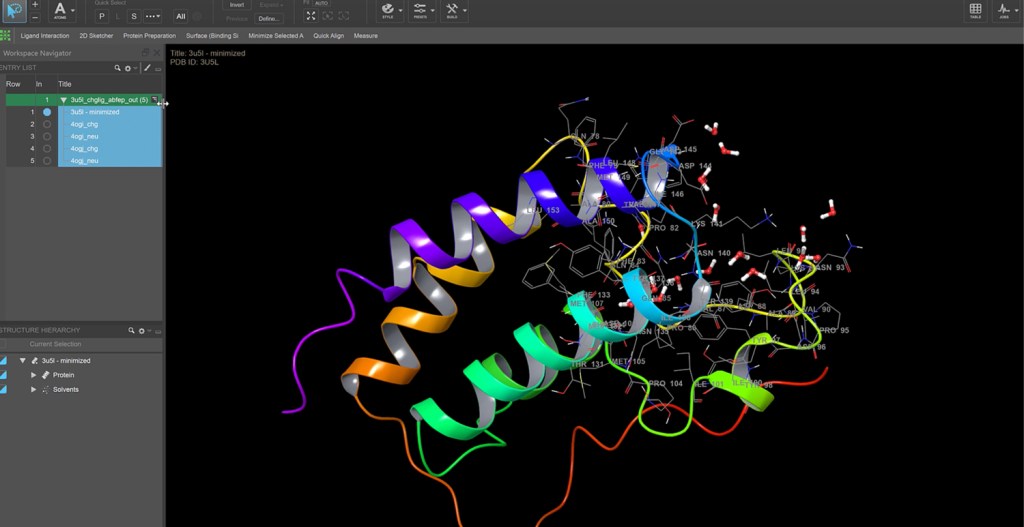
Maestro Viewer is an intuitive interface for academic users to visualize and manipulate 3D structures using Schrödinger’s powerful rendering capabilities and chemical building tools. Maestro Viewer provides academic users the opportunity to gain familiarity with the Maestro interface and its visualization capabilities.

Maestro Viewer does not include access to molecular property predictions or the ability to run molecular simulations and is only available with an academic account.

What you can do with Maestro Viewer

  • Visualize and manipulate 3D structures
  • Gain an introduction to the Maestro interface
  • Load and view most pre-run simulation results from Maestro
  • View applications and workflows available in Maestro
 

Ready to explore the full potential of Schrödinger tools?

Maestro is a powerful molecular modeling environment for accessing cutting-edge physics-based molecular simulation workflows, state-of-the-art machine learning, and advanced structure visualization. 

Academic Site License

Expand your access with large scale, university-wide access to Schrödinger software. Perform cutting edge research and train the next generation of scientists at your university with Schrödinger’s most comprehensive set of large-scale software licenses, spanning life science and materials science applications.

Schrödinger Materials Science Seminar Japan 2024 

Webinar

Schrödinger Materials Science Seminar Japan 2024

CalendarDate & Time
  • June 4th-7th, 2024
LocationLocation
  • Virtual

《無料Webセミナー》材料開発向けシミュレーション·ソフトウェアおよびマテリアルズ·インフォマティクスの活用事例を紹介

半導体や電子部品から日用品に至るまで、あらゆる材料開発において、計算化学は近年では欠かせない基盤技術の一つとしてその存在を確立しつつあります。

シュレーディンガーは、1990年の会社創立以来、分子設計向けソフトウェアとインフォマティクスの機能強化に継続的に取り組み、様々な材料開発の効率化への実用的なソリューションとして提供しています。

この度、これらのソフトウェアを活用した事例をご紹介するセミナーを開催します。

シミュレーションや機械学習のご経験がある方はもちろん、これから手掛けるという方にもご満足いただける内容になっております。

ご興味のあるセッションのみの聴講も大歓迎ですので、ぜひお気軽にご参加ください。

各発表のアブストラクトはこちらからご覧いただけます。

icon time ⽇本時間10:00AM – 11:00AM
Advancing Polymer Design and Analysis through Integrated Machine Learning and Molecular Modeling Techniques

Mohammad Atif Faiz Afzal, Ph.D., Principal Scientist, Schrödinger

icon time ⽇本時間11:00AM – 12:00AM
可視光応答型の水分解光触媒に向けた新規チタン酸窒化物化合物の探索

シュレーディンガー株式会社 シニア サイエンティスト 青木 祐太(博士(理学))

icon time ⽇本時間10:00AM – 11:00AM
Accelerating the innovation of next generation cosmetics and food products through computational chemistry

Haidong Liu, Ph.D., Senior Scientist II, Schrödinger

icon time ⽇本時間11:00AM – 12:00AM
Automated Digital Prediction of Chemical Degradation Products

Pavel A. DUB, Senior Principal Scientist, Schrödinger

icon time ⽇本時間5:00PM – 6:00PM
Efficient computation of process parameters for controlling the chemistry of deposition or etch – atomic-scale mechanism, thermodynamic competition and microkinetic modelling

Simon D. Elliott, Ph.D., Director – Atomic level process simulation, Schrödinger

icon time ⽇本時間10:00AM – 11:00AM
Leveraging Schrödinger’s Digital Chemistry Platform for Accelerated Development of Next-Generation Battery Materials

Garvit Agarwal, Ph.D., Scientific Lead, Energy Storage, Schrödinger

icon time ⽇本時間11:00AM – 12:00AM
全固体電池の負極保護膜についての解析

シュレーディンガー株式会社 シニア サイエンティスト 井本 文裕(博士(工学))

icon time ⽇本時間10:00AM – 11:00AM
データ駆動型材料研究のための計算プラットフォームLiveDesign

シュレーディンガー株式会社 ストラテジック デプロイメント マネージャー 石崎 貴志(博士(理学))・シニア ソリューション アーキテクト 山田 淳美

icon time ⽇本時間11:00AM – 12:00AM
Materials Science Suiteに含まれる有機EL材料開発のためのプログラム紹介

シュレーディンガー株式会社 シニア サイエンティスト 大塚 勇起(博士(工学))

【セミナー形式】
Zoom webinarを使⽤したオンライン形式
海外からの講演者は英語での発表となります。
※Presentations by Japanese speakers are available in Japanese only.

【お申込み⽅法】
参加のお申し込みはこちらから▼
https://schrodinger.zoom.us/webinar/register/WN_dbPy5O52RASAIqAp1xfJcQ#/registration

所属企業または所属機関のメールアドレスにて、ご登録をお願いします。
所属が明らかでない、また、個⼈メールアドレスでご登録の場合などは、出席をご遠慮いただく場合がございますのであらかじめご了承ください。参加お⼀⼈様につき⼀登録をお願いします。アクセスリンクの共有はご遠慮ください。
当⽇は、お申し込みの際に登録いただいた⽒名·メールアドレスにてご参加ください。
同業他社さまには参加をご遠慮頂いております。申し訳ございませんが、ご理解のほど宜しくお願い致します。

ご質問、ご不明な点がございましたら下記までお問い合わせください。
シュレーディンガー株式会社
E-mail: info-japan@schrodinger.com

DDF Summit 2024

Conference

DDF Summit 2024

CalendarDate & Time
  • May 21st-23rd, 2024
LocationLocation
  • Berlin, Germany

Schrödinger is excited to be participating in the DDF Summit taking place on May 21st – 23rd in Berlin, Germany. Join us for a presentation by John Shelley, Fellow at Schrödinger, titled “Molecular Modeling and Machine Learning for Small Molecule and Biologic Drug Formulation.”

Speaker

John Shelley

Fellow

John earned a MSc from the University of Waterloo in theoretical chemistry and a PhD from the University of Pennsylvania in computational chemistry.  Following post-doctoral research in computational chemistry at the University of British Columbia, he worked for Procter & Gamble studying surfactant structures in solution.  For the last 23 years, John has worked for Schrödinger, LLC, as a scientific software developer and a research scientist, managing a number of products including the Materials Science Coarse-Grained product.  John has focused on computer modeling of drug formulations for much of the last 8 years.

Abstract:

Selecting and combining the right ingredients in the appropriate manner is essential for successful drug formulation given the inherent challenges and competitive market. With advances in modern machine learning, physics-based simulation techniques and computer hardware, modelling is emerging as a valuable source of information that complements experimental characterization.  We showcase a cross-section of capabilities within Schrödinger’s Suite for modeling related to formulations of small-molecule or biologic drugs.
For small-molecule drugs workflows have been created for characterizing crystal polymorphs, crystal morphology and degradation risks as well as calculating elastic constants (bulk modulus, shear modulus, etc.), powder diffraction patterns, glass transition temperatures (Tg), diffusion constants, pKa values, melting points, water adsorption and various solubilities. For biologics our toolset supports homology modeling, and the calculation of aggregation propensity, titration curves, isoelectric points and viscosity among other things.
Complex and evolving structures, often in fluid states, play a crucial role in the pharmaceutical industry.   For both small-molecule and biologics formulations powerful simulation tools employing atomistic or coarse-grained models to permit the characterization of molecular interactions and nanoscale structuring, sometimes within otherwise disordered bulk systems (e.g., LNP formation, self-assembly of polymer-based structures, dissolving amorphous solid dispersions, liposomes and protein-excipient interactions).

Key Learning Objectives:

  • Advances in crystal structure prediction
  • API and excipient physical and chemical property prediction from molecular modeling and machine learning
  • Molecular modeling for lipid nanoparticles
  • Molecular modelling provides data and a basic understanding of the behaviour of drug formulations that compliments experimental data and machine learning to inform decision making

SID Display Week

Conference

SID Display Week

CalendarDate & Time
  • May 12th-17th, 2024
LocationLocation
  • San Jose, California

Schrödinger is excited to be participating in the SID Display Week conference taking place on May 12th – 17th in San Jose, California. Stop by booth 1634 to speak with Schrödinger scientists.

Join us for a free workshop day on May 15th in Meeting Room 213. Schrödinger experts will walk you through guided demos and help you gain hands-on experience using digital simulations to expedite your organic electronics R&D. Register for the workshop here.

icon time May 16 | 11:40 AM – 12:10 PM
icon location Exhibit Hall Center Stage
Revolutionizing Organic Electronics: Computational Insights and Innovations in OLED Materials Design

Speaker: Hadi Abroshan, Principal Scientist, Schrödinger

icon time May 17 | 10:00 AM – 10:20 AM
icon location San Jose Convention Center, LL21CD
Digital Chemistry, Data Processing, and Collaborative Ideation for Development of OLEDs

Speaker: Hadi Abroshan, Principal Scientist, Schrödinger

Abstract: Empowered by digital chemistry and informatics platforms, this study highlights the transformative impact of physics-based simulation, machine learning, and data management in display industry R&D. This technology integration accelerates ideation and decision-making, ensuring swift, accurate, and cost-effective development for next-generation display devices.