LiveDesign

LiveDesign for Materials Science

Your complete digital materials design lab
LiveDesign for Materials Science

Digitally design, predict, analyze, and collaborate in a single platform

Democratize your digital design process for new materials, formulations, and chemical processes by harnessing the power of physics-based modeling, advanced cheminformatics, chemistry-informed machine learning, virtual design and analysis technologies, and centralized access to project data – all from a single interface.

Real-time collaborative design, modeling, and project management to accelerate materials design

Bridge the gap between your real and virtual data

Break data silos and gain real-time access to all project data — virtual and experimental — in a single centralized platform

Drive faster, better materials design

Empower creativity and capture your best ideas with powerful predictive modeling workflows at your fingertips

Centralize collaboration and decision-making

Crowdsource ideas and interactively revise design strategies with your colleagues – anytime, anywhere

Key Capabilities

Data visualization and management

Intuitive, user-friendly tools to import compounds from files, run computational models, and view 3D results. Search for experimental data, add custom formulas, and flag interesting compounds for follow-up.

Deploying and tracking predictive models

Sophisticated, expert tools to set up and modify complex scientific simulations and enable everyone on the team to run the simulations on imported or sketched materials. Computational results automatically appear side-by-side with other data of the same material.

Data analysis and machine learning

Customized and focused insights into data with comprehensive, easy-to-use data analysis tools, such as multi-parameter optimization (MPO), multi-dimensional plots, tile view, and form view. Machine learning technology embedded on the platform speeds up material design cycles.

bg-circle

Functionality for a broad range of industries

Customize LiveDesign for various materials applications and project areas
Organic Electronics

Organic Electronics

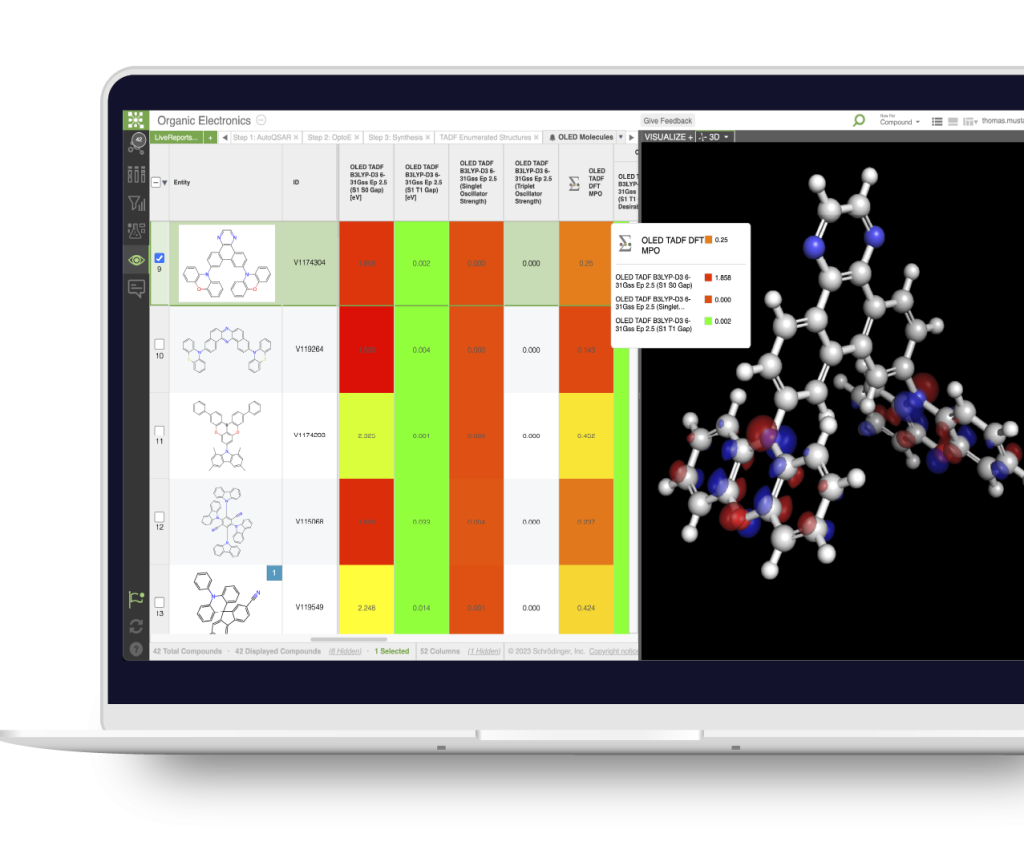
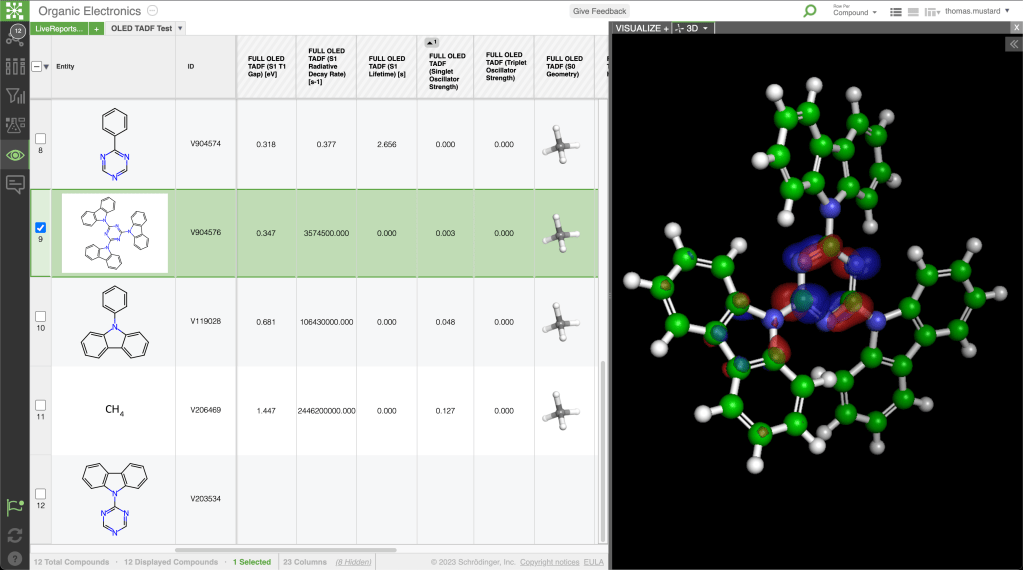
Automate and streamline sophisticated molecular and bulk simulations and analysis to predict important optoelectronic properties, while assessing the key performance of novel electronic materials based on both physics-based and data-driven methods
Catalysis & Reactivity

Catalysis & Reactivity

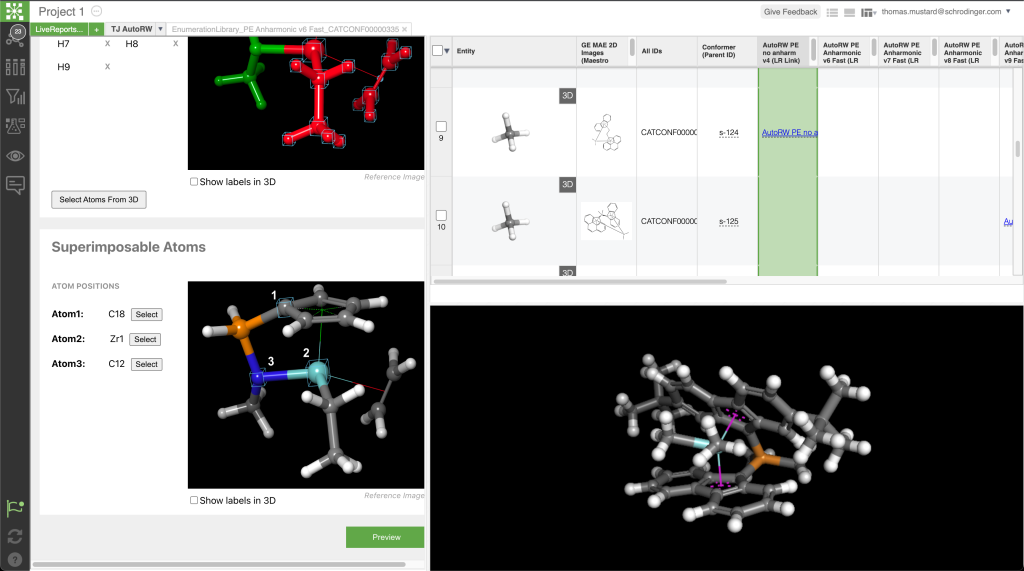
Efficient, highly-automated solutions for computational design of catalytic and non-catalytic reactivity leveraging the combination of quantum mechanics, molecular dynamics, and machine learning
Thin Film Processing

Thin Film Processing

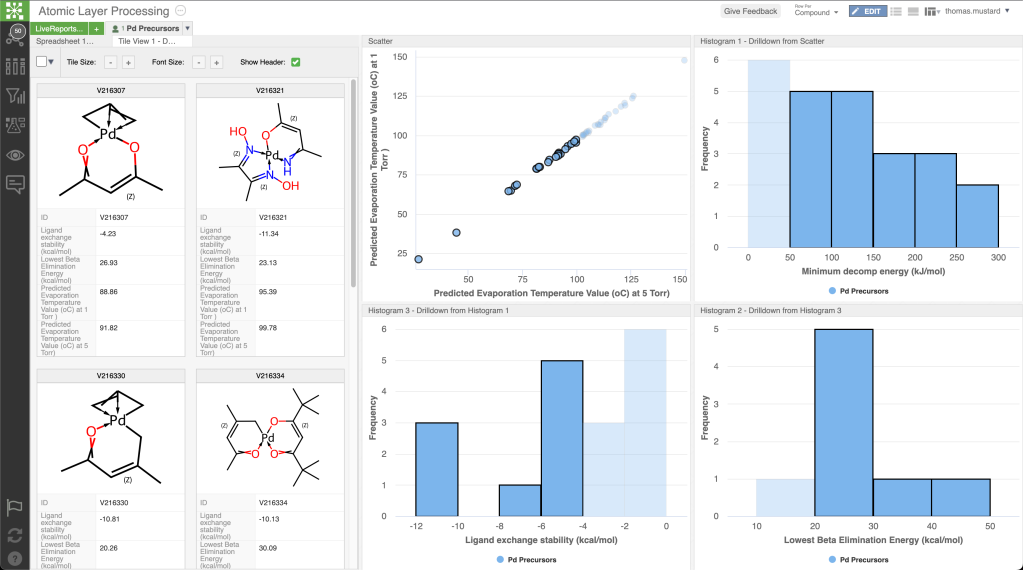
Apply machine learning technology to experimental and simulated data to find out how properties of chemicals, process conditions, and integration schemes all contribute to the final performance of devices in areas such as logic, memory, sensing, or energy conversion
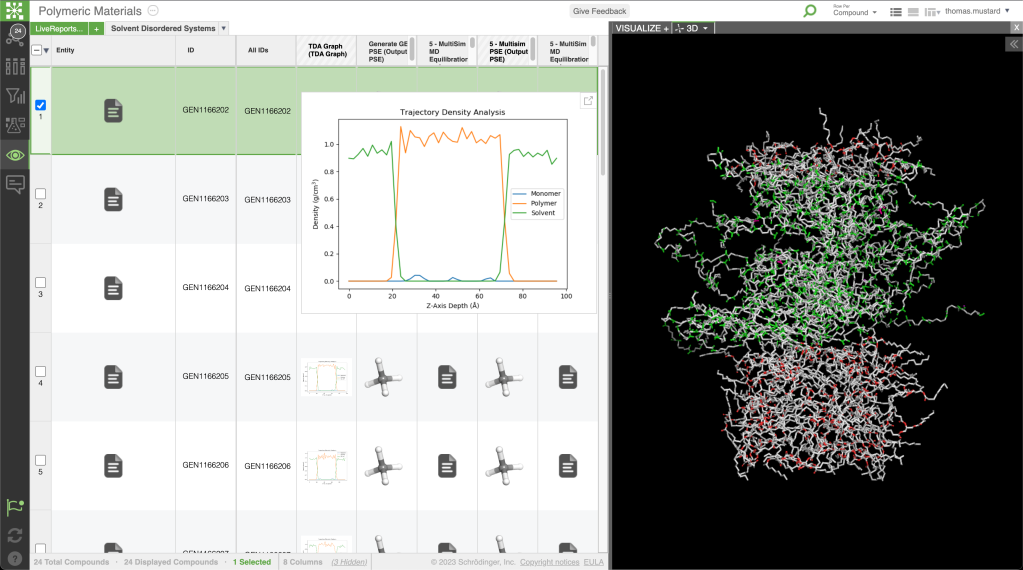
Polymeric Materials

Polymeric Materials

Design polymer monomers and formulations with embedded polymer sketching and integration of predictive models including machine learning and physics-based simulations
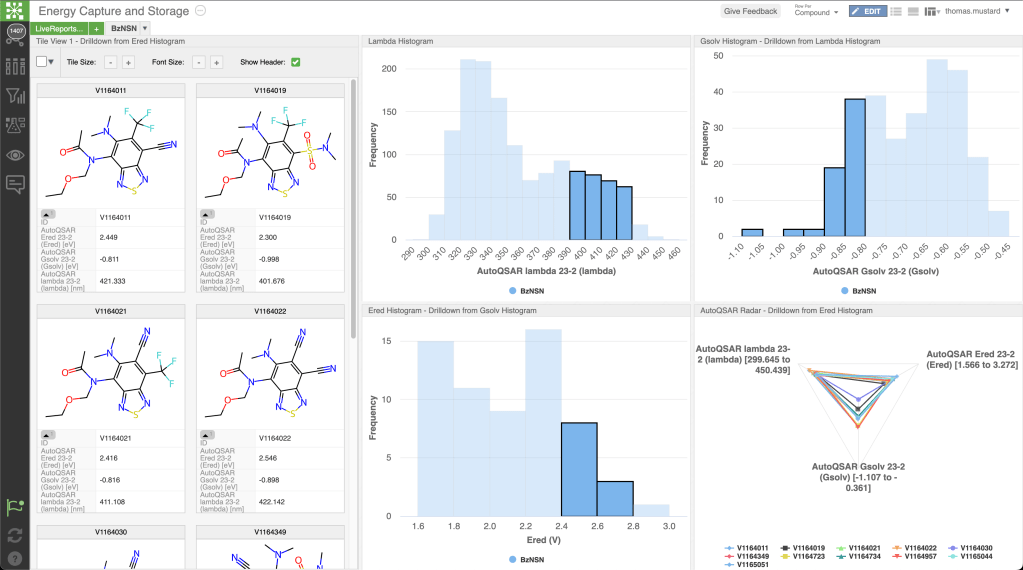
Energy Capture & Storage

Energy Capture & Storage

Optimize electrolyte formulations, electrode structure, and cell-level performance simultaneously using advanced informatics, hierarchical machine-learning, and multi-scale physics-based simulations

Documentation & Tutorials

Get answers to common questions and learn best practices for using Schrödinger’s software.

Life Science Tutorial

The LiveDesign Assistant

Learn how to build and adjust coloring rules, create Freeform and Formula columns, and plot data using the LiveDesign Assistant.

Life Science Tutorial

Build a Residual LogD Machine Learning Model in LiveDesign

Learn how to build a Residual logD machine learning model using AlogP as a prospective triage filter for solubility and hepatotoxicity risk.

Life Science Tutorial

RetroSynth in LiveDesign

Leverage project-specific chemistry via known building blocks and transformations to promote relevant synthetic routes for your CRO.

Life Science Tutorial

Reaction-Based Enumeration Using a Provided Reaction

Select a Schrödinger reaction, configure reactants, explore reaction output options, and generate enumerated products.

Life Science Tutorial

R-Group Enumeration in LiveDesign

Explore the chemical space around a scaffold using R-group libraries.

Life Science Tutorial

Ligand Designer Configurations

Set up the Ligand Designer for interactive 3D ligand editing using existing Glide models or manual file imports.

Life Science Tutorial

Ligand Designer in LiveDesign

Learn how to select, design, edit, and run docking predictions for a molecule within the Ligand Designer in LiveDesign.

Life Science Tutorial

Limited Assay Columns in LiveDesign

Learn how to display different assay data in the LiveReport.

Life Science Video

Introducing the 2D Sketcher

An overview of modes, shortcut keys, mouse actions, and right-click menus.

Life Science Documentation

Formula Column Examples

Explore formula column examples that allow you to calculate, analyze, and transform data using custom expressions and built-in functions.

  • Materials Science
  • White Paper

An automated workflow for rapid large-scale computational screening to meet the demands of modern catalyst development
Learn how Schrödinger’s AutoRW and LiveDesign enable rational catalyst design in an automated, accelerated, and collaborative manner on a single, collaborative web-based platform.

Read white paper
  • Materials Science
  • White Paper

LiveDesign for Organic Electronics
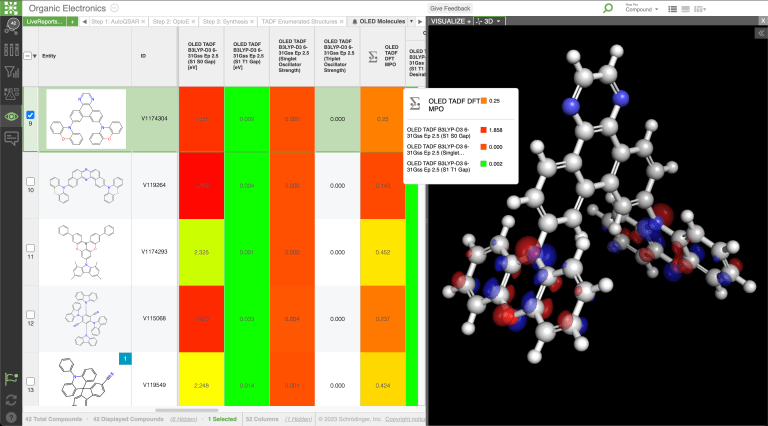
Schrödinger’s LiveDesign is a flexible, cloud-native working environment to democratize digital design processes for new materials and improved formulations across R&D teams.

Read white paper

Training & Resources

Online certification courses

Level up your skill set with hands-on, online molecular modeling courses. These self-paced courses cover a range of scientific topics and include access to Schrödinger software and support.

Tutorials

Learn how to deploy the technology and best practices of Schrödinger software for your project success. Find training resources, tutorials, quick start guides, videos, and more.
MS Informatics

MS Informatics

Automated machine learning tools for materials science applications

Materials Science Informatics

Overview

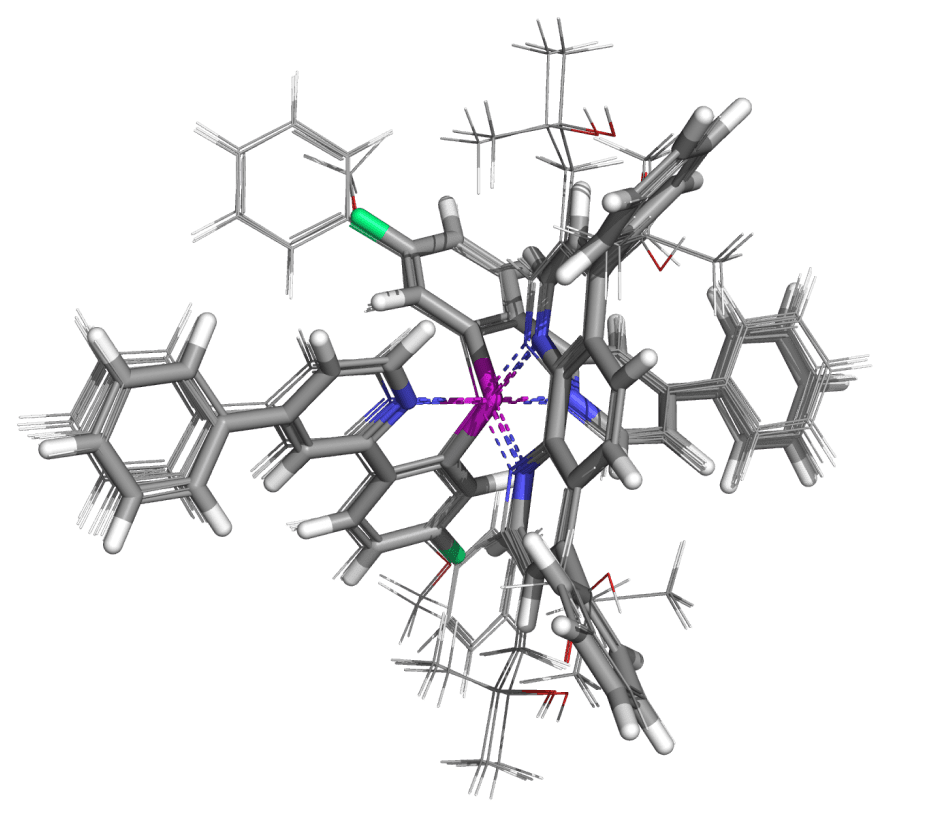
MS Informatics provides molecular featurization and machine learning (ML) tools for organic, organometallic, polymer, chemical mixture (i.e., formulation), and inorganic solid materials to help design new materials through data driven approaches. By combining physics-based featurization, customized pretrained ML models, and automated workflows to train and evaluate ML models, users can take advantage of the computationally efficient data-driven approaches to screen and down select promising materials.

Key Capabilities

Build accurate material-property relationships using computationally efficient machine learning models for organic molecules, polymers, formulations, and more
Enhance model predicability with advanced, physics-informed descriptors for organic, inorganic, and polymer materials using cheminformatics, semi-empirical approaches, quantum mechanics (QM), and molecular dynamics (MD)
Use pre-trained ML models to predict properties such as polymer glass transition temperature, viscosity, density, and a variety of optoelectronic properties for molecules
Interact through an intuitive GUI to perform single-point and geometry optimization using Schrödinger’s universal machine learning force field (MPNICE) for both periodic and gas-phase systems

Case studies & webinars

Discover how Schrödinger technology is being used to solve real-world research challenges.

Materials Science Webinar

Formulation machine learning and optimization for accelerated materials discovery recording

Join our upcoming webinar to learn how your R&D team can leverage automated data driven solutions to guide the design of versatile chemical solutions.

Materials Science Webinar

Formulation machine learning and optimization for accelerated materials discovery

Join our upcoming webinar to learn how your R&D team can leverage automated data driven solutions to guide the design of versatile chemical solutions.

Materials Science Webinar

Formulation ML and Optimization: Making advanced property prediction and experimental design fast and accessible recording gated

We will showcase how easy it is to apply these tools using experimental datasets across broad MS applications, including formulations, consumer goods, batteries, pharmaceuticals, and beyond.

Materials Science Webinar

Formulation ML and Optimization: Making advanced property prediction and experimental design fast and accessible recording

We will showcase how easy it is to apply these tools using experimental datasets across broad MS applications, including formulations, consumer goods, batteries, pharmaceuticals, and beyond.

Materials Science Webinar

Formulation ML and Optimization: Making advanced property prediction and experimental design fast and accessible

We will showcase how easy it is to apply these tools using experimental datasets across broad MS applications, including formulations, consumer goods, batteries, pharmaceuticals, and beyond.

Materials Science Webinar

Formulation ML and Optimization: Making advanced property prediction and experimental design fast and accessible

We will showcase how easy it is to apply these tools using experimental datasets across broad MS applications, including formulations, consumer goods, batteries, pharmaceuticals, and beyond.

Materials Science Webinar

Accelerating OLED innovation with multi-scale, multi-physics simulations

Join us to explore how integrated digital workflows drive the design of next-generation, high-performance OLEDs.

Materials Science Case Study

The Future of Food: Molecular Simulations and AI/ML Reshaping Product Development

Materials Science Webinar

AI/ML meets physics-based simulations: A new era in complex materials design

In this webinar, we demonstrate the application of this combined approach in designing materials and formulations across diverse materials science applications, from battery electrolytes and fuel mixtures to thermoplastics and OLED devices. 

Materials Science Webinar

Electrodes, electrolytes & interfaces: Harnessing molecular simulation and machine learning for rapid advancements in battery materials development

In this webinar, we demonstrate the application of automated solutions for accurate prediction of electrode materials.

Includes pretrained machine learning models to predict a diverse range of properties

Boiling point and vapor pressure of organic and organometallic compounds
Glass transition temperature of polymers
Frequency-dependent polymer dielectric constant and dielectric loss
Density of small molecules
Viscosity of small molecules
Aqueous solubility of organic molecules
Non-aqueous solubility
Melting point
HOMO/LUMO
Optoelectronic properties

Absorption and emission peak position and bandwidth (FWHM)
Extinction coefficient
Emission lifetime
Photoluminescence quantum yield (PLQY)
Singlet-triplet energy gap (S1-T1)
Oxidation and reduction potentials

Broad applications across materials science research areas

Get more from your ideas by harnessing the power of large-scale chemical exploration and accurate in silico molecular prediction.

Catalysis & Reactivity
Energy Capture & Storage
Organic Electronics
Polymeric Materials
Pharmaceutical Formulations & Delivery
Consumer Packaged Goods

Documentation & Tutorials

Get answers to common questions and learn best practices for using Schrödinger’s software.

Materials Science Tutorial

Machine Learning with MPNICE Embedding

Learn to build, analyze, and apply ML models with MPNICE Embedding.

Materials Science Tutorial

De Novo Design of Novel Compounds with REINVENT

Learn to train a generative ML model with REINVENT to design new compounds with property constraints.

Materials Science Tutorial

Machine Learning for Formulations Containing Proteins

Learn to build machine learning models for formulations including proteins.

Materials Science Documentation

MS Informatics

Automated machine learning tools for materials science applications

Materials Science Documentation

Materials Science Panel Explorer

Quickly learn which Schrödinger tools are the best fit for your research.

Materials Science Tutorial

Machine Learning for Formulations

Learn to build and apply machine learning models to predict the density of multicomponent mixtures.

Materials Science Tutorial

Periodic Descriptors for Inorganic Solids

Generate descriptors for inorganic periodic crystal systems which can be used to build machine learning models.

Materials Science Tutorial

Polymer Descriptors for Machine Learning

Generate descriptors for polymers which can be used to build machine learning models.

Materials Science Tutorial

Molecular Dynamics Descriptors for Machine Learning

Generate descriptors using molecular dynamics simulation, which can be used to build machine learning models.

Materials Science Tutorial

Machine Learning for Ionic Conductivity

Generate descriptors for ionic liquids which can be used to build machine learning models.

Related Products

Learn more about the related computational technologies available to progress your research projects.

MS Formulation ML

Automated machine learning solution to generate accurate formulation-property relationships and screen new formulations with desired properties

MS Force Field Applications

Cutting-edge force field technologies for accurate property predictions

Jaguar

Quantum mechanics solution for rapid and accurate prediction of molecular structures and properties

OLED Device ML

Machine learning solution to investigate relationships between the architecture and performance of OLED devices for accelerated screening

MS Maestro

Complete modeling environment for your materials discovery

DeepAutoQSAR

Automated, scalable solution for the training and application of predictive machine learning models

AutoTS

Automatic workflow for locating transition states for elementary reactions

Quantum ESPRESSO Interface

Integrated graphical user interface for nanoscale quantum mechanical simulations

Publications

Browse the list of peer-reviewed publications using Schrödinger technology in related application areas.

Materials Science Publication

Data-Driven Design of Organic Semiconductors Exhibiting Low Reorganization Energy via Hierarchical Variational Autoencoders, Gaussian Mixture Regression, and Bayesian Optimization

Materials Science Publication

Multiobjective Design of Electrolyte Solvents via Physics-Based Modeling and Reinforcement Learning

Materials Science Publication

Screening Antioxidant Ingredients Using Quantum Mechanics and Machine Learning

Materials Science Publication

RedCat, an automated discovery workflow for aqueous organic electrolytes

Materials Science Publication

Band Gap and Reorganization Energy Prediction of Conducting Polymers by the Integration of Machine Learning and Density Functional Theory

Materials Science Publication

Leveraging high-throughput molecular simulations and machine learning for the design of chemical mixtures

Materials Science Publication

Designing polymersomes with surface-integrated nanoparticles through hierarchical phase separation

Materials Science Publication

Synthesis, optical and electrochemical properties of thiophene and thieno [3, 2-b] thiophene linked with structurally modified rhodanine based copolymers

Materials Science Publication

Stability enhancement of Amphotericin B using 3D printed biomimetic polymeric corneal patch to treat fungal infections

Materials Science Publication

Advancing efficiency in deep-blue OLEDs: Exploring a machine learning–driven multiresonance TADF molecular design

Training & Resources

Online certification courses

Level up your skill set with hands-on, online molecular modeling courses. These self-paced courses cover a range of scientific topics and include access to Schrödinger software and support.

Tutorials

Learn how to deploy the technology and best practices of Schrödinger software for your project success. Find training resources, tutorials, quick start guides, videos, and more.

Desmond

Desmond for Materials Science

High-performance molecular dynamics (MD) engine providing high scalability, throughput, and scientific accuracy

Understand and predict key properties of materials with fast, accurate molecular dynamics

Desmond is a GPU-powered high-performance molecular dynamics (MD) engine for predicting bulk properties of materials, such as thermophysical properties, elastic constants, stress/strain relationships, diffusion coefficients, viscosity, persistence length, free energy of solvation, and more. Desmond also characterizes structure and properties in complex systems involving non-equilibrium systems as well as interfaces or self-assembled structures.

Comprehensive molecular dynamics capabilities

Exceptional performance

Achieve exceptional throughput on commodity Linux clusters with both typical and high-end networks. Improve computing speed by 100x on general-purpose GPU (GPGPU) versus single CPU.

Superior accuracy

Constructed with a focus on numerical accuracy, stability, and rigor. Enables the simulation of large scale features of nanometers to micron size over time scales of picoseconds to microseconds.

Trusted energetics

Provides a robust framework for the calculation of energies and forces for atomistic and coarse grained force field models. Compatible with chemistries commonly used in both biomolecular and condensed-matter research.

Realistic simulations

Perform explicit solvent simulations with periodic boundary conditions using cubic, orthorhombic, truncated octahedron, rhombic dodecahedron, and arbitrary triclinic simulation boxes with careful attention to the efficient and accurate calculation of long-range electrostatics, and can be used to model explicit membrane systems, complex mixtures, polymers, and interfaces under various conditions.

Easy-to-use interface

Support automated simulation setup, including multistage MD simulations with built-in simulation protocols, prediction of equation of states (EOS) at multiple temperatures, and advanced techniques such as non-equilibrium dynamics and enhanced sampling. An intuitive interface provides intelligent default settings and allows for rapid setup of computational experiments.

Powerful analysis tools

Visualize and examine computed results within the same MS Maestro modeling environment that connects to a comprehensive suite of modeling tools from quantum mechanics to machine learning.

Case studies & webinars

Discover how Schrödinger technology is being used to solve real-world research challenges.

Materials Science Webinar

Beyond the bench: Getting started with molecular dynamics simulations

Join Schrödinger’s Katie Dahlquist, as she’ll show you how Desmond can be used to improve your development.

Materials Science Webinar

Beyond the bench: Getting started with molecular dynamics simulations recording

Join Schrödinger’s Katie Dahlquist, as she’ll show you how Desmond can be used to improve your development.

Materials Science Case Study

Advancing sustainable food processing through integrated experimental and molecular simulation approaches

Scientists from Schrödinger and UMass carried out comprehensive studies experimentally and computationally to investigate the key properties and extrusion performance of zein-formulated meat alternatives.

Materials Science Webinar

Accelerating OLED innovation with multi-scale, multi-physics simulations

Join us to explore how integrated digital workflows drive the design of next-generation, high-performance OLEDs.

Materials Science Case Study

The Future of Food: Molecular Simulations and AI/ML Reshaping Product Development

Materials Science Case Study

Advancing the design and optimization of drug formulations with combined computational and experimental approaches

Materials Science Case Study

Characterizing lipid nanoparticle self-assembly and structure using coarse-grained simulations

Materials Science Case Study

Designing better packaging materials with a reduced risk of contamination and longer shelf-life using molecular simulations 

Materials Science Webinar

Schrödinger Materials Science Seminar Japan 2024 

《無料Webセミナー》材料開発向けシミュレーション・ソフトウェアおよびマテリアルズ・インフォマティクスの活用事例を紹介。

Materials Science Webinar

Taking experimentation digital: Materials innovation using atomistic simulation and machine learning at-scale

In this webinar, we introduce a modern approach to materials R&D using a digital chemistry platform for in silico analysis, optimization and discovery.

Broad applications across materials science research areas

Get more from your ideas by harnessing the power of large-scale chemical exploration and accurate in silico molecular prediction.

Polymeric Materials
Pharmaceutical Formulations & Delivery
Energy Capture & Storage
Organic Electronics
Consumer Packaged Goods

Official NVIDIA Partner

Schrödinger has a strategic partnership with NVIDIA to optimize our computational drug discovery platform for NVIDIA GPU technology.

Documentation & Tutorials

Get answers to common questions and learn best practices for using Schrödinger’s software.

Materials Science Tutorial

Protein Characterization: Part 2

Explore the characterization of bovine β-lactoglobulin proteins across various pH levels by performing and analyzing molecular dynamics simulations.

Materials Science Tutorial

Protein Characterization: Part 1

Learn a protein characterization workflow: preparing the structure, analyzing surface properties, and performing mixed solvent molecular dynamics.

Materials Science Tutorial

Ionic Conductivity

Learn to calculate the ionic conductivity.

Materials Science Tutorial

Locating Adsorption Sites on Surfaces

Learn how to locate adsorption sites on surfaces.

Materials Science Tutorial

Simulating Complex Protein Solutions

Learn to prepare a complex protein system for a Molecular Dynamics (MD) simulation.

Materials Science Tutorial

Building and Analyzing a Complex Lipid Bilayer and Embedding a Membrane Protein

Learn to build and analyze a complex lipid bilayer and how to embedd a protein.

Materials Science Documentation

Machine Learning Force Fields

Machine Learning Force Fields (MLFFs) offer a novel approach for predicting the energies of arbitrary systems.

Materials Science Tutorial

Machine Learning Force Field

Learn how to use machine learning force field optimization methods to prepare and simulate various systems.

Materials Science Documentation

Desmond

Simulate biological systems with a GPU-powered high-performance molecular dynamics (MD) engine.

Materials Science Tutorial

Nanoemulsions with Automated DPD Parameterization

Learn how to automatically build a coarse-grained force field for dissipative particle dynamics (DPD) from a nanoemulsions system with water and perform a molecular dynamics simulation.

Related Products

Learn more about the related computational technologies available to progress your research projects.

Virtual Cluster

Secure, scalable environment for running simulations on the cloud

MS Maestro

Complete modeling environment for your materials discovery

OPLS4 & OPLS5 Force Field

A modern, comprehensive force field for accurate molecular simulations

MS CG

Efficient coarse-grained (CG) molecular dynamics (MD) simulations for large systems over long time scales

MS Morph

Efficient modeling tool for organic crystal habit prediction

MS Penetrant Loading

Molecular dynamics (MD) modeling for predicting water loading and small molecule gas adsorption capacity of a condensed system

MS Transport

Efficient molecular dynamics (MD) simulation tool for predicting liquid viscosity, conductivity and diffusions of atoms and molecules

Publications

Browse the list of peer-reviewed publications using Schrödinger technology in related application areas.

Materials Science Publication

Material Property Simulation for Advanced Packaging

Life Science Publication

STX-721, a Covalent EGFR/HER2 Exon 20 Inhibitor, Utilizes Exon 20–Mutant Dynamic Protein States and Achieves Unique Mutant Selectivity Across Human Cancer Models

Life Science Publication

A robust crystal structure prediction method to support small molecule drug development with large scale validation and blind study

Materials Science Publication

Uncovering the light absorption mechanism of the blue natural colorant allophycocyanin from Arthrospira platensis using molecular dynamics

Materials Science Publication

Evaluating the Binding Potential and Stability of Drug-like Compounds with the Monkeypox Virus VP39 Protein Using Molecular Dynamics Simulations and Free Energy Analysis

Materials Science Publication

Predicting Drug-Polymer Compatibility in Amorphous Solid Dispersions by MD Simulation: On the Trap of Solvation Free Energie

Materials Science Publication

Possible Applications of the Polli Dissolution Mechanism: A Case Study Using Molecular Dynamics Simulation of Bupivacaine

Materials Science Publication

Designing the Next Generation of Polymers with Machine Learning and Physics-Based Models

Materials Science Publication

Modelling of Prednisolone Drug Encapsulation in Poly Lactic-co-Glycolic Acid Polymer Carrier Using Molecular Dynamics Simulations

Materials Science Publication

Cu-TiO2/Zeolite/PMMA Tablets for Efficient Dye Removal: A Study of Photocatalytic Water Purification

Schedule a consultation on Schrödinger’s molecular dynamics solutions

Contact us today to explore how you can leverage advanced molecular dynamics simulations to drive innovation and gain competitive advantage in your industry.

Don’t see your areas of interest above? Reach out so we can help.

Form submitted

Thank you, we’ll be in touch soon.

Training & Resources

Online certification courses

Level up your skill set with hands-on, online molecular modeling courses. These self-paced courses cover a range of scientific topics and include access to Schrödinger software and support.

Tutorials

Learn how to deploy the technology and best practices of Schrödinger software for your project success. Find training resources, tutorials, quick start guides, videos, and more.

Virtual Screening Web Service

background pattern

Virtual Screening Web Service

Virtual, novel hits from a billion-compound library delivered in one week

Increase the likelihood of finding diverse and novel virtual hits in your virtual screening campaigns

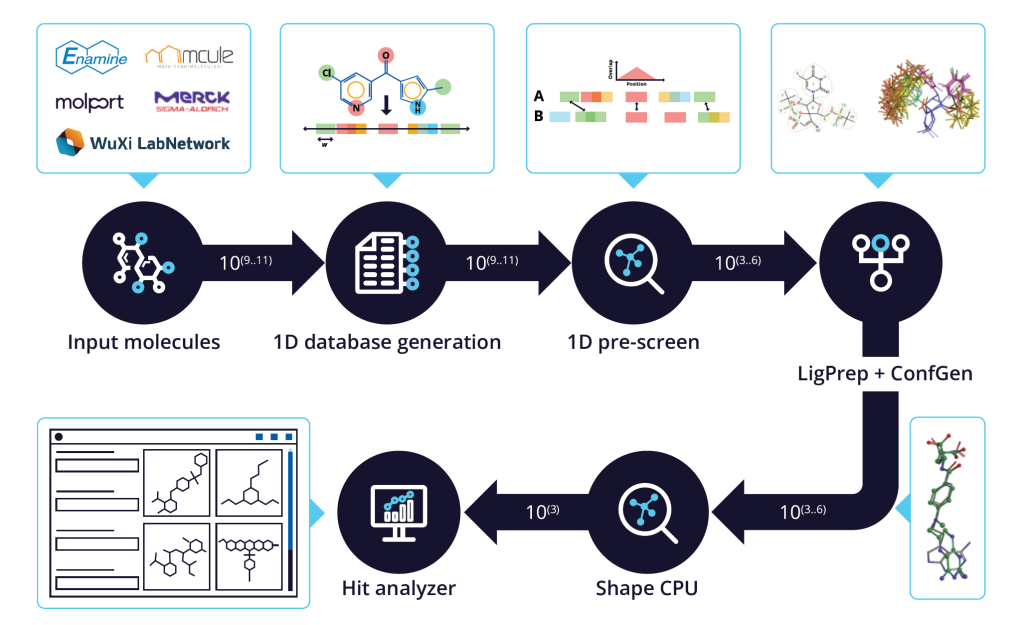
The Virtual Screening Web Service delivers secure access to industry-leading hit identification methods and burst computing power to perform ultra-large screens quickly and efficiently.

Successful virtual screens produce chemically diverse molecules with affinity to a target protein
Maximize the diversity of hits by screening ultra-large-scale purchasable compound libraries through the combined power of physics-based methods and machine learning.

Access industry-leading virtual screening workflows in the cloud
Schrödinger’s Virtual Screening Web Service accommodates the demands of teams with occasional large-scale screening needs but who lack the infrastructure or technical resources to screen in-house efficiently.

Identify novel hits from libraries of >1B compounds in a week

Fully automated screening workflow

Benefit from on demand cloud-based workflows with the click of a button.

Built-in scientific validation

Ensure desired screening goals through a gated, built-in pilot study.

Results in one week

Keep projects on schedule by leveraging the power of massive parallel compute environments.

Easily sourced compounds

Use vendor compound IDs associated with every virtual hit to easily purchase compounds.

Secure, exclusive cloud server

Ensure legal and security compliance through a dedicated data server with enterprise-grade security.

Diverse and novel IP discovery

Access over a billion compounds, allowing exploration of more avenues for program progression.

Access industry-leading 3D docking workflows amplified by machine learning

Apply 3D docking techniques

Find novel scaffolds beyond training sets using extrapolative 3D screening methods. 2D screening methods have prediction limitations, while 3D docking methods can extrapolate into novel chemical space.

Accelerate screens with machine learning

Leverage machine learning to accelerate 3D docking methods. Accurate docking methods coupled with machine learning techniques make 1+ billion compounds screens straightforward and cost-effective.

Benefit from parallel screening approaches

Use multiple virtual screening approaches for the highest chemical diversity. Different screening technologies are shown to produce unique ligand scaffolds.

bg-circle

How it Works:
Automate screens of more than a billion purchasable compounds virtually

  1. Upload one or more virtual screening inputs which include the docking model, shape screening probes, and known active compounds.
  2. Select multiple libraries to screen including one billion library.
  3. Review results of pilot screen to assess likelihood of active active learning Glide finding high quality hits for your target.
  4. Launch the fully automated ultra-large-scale screen once satisfied with pilot screen results.
  5. Receive thousands of virtual hits within one week and access all data from an enterprise-grade secure server.
Enamine
MolPort
Sigma-Aldrich
MCule

Related Products

Learn more about the related computational technologies available to progress your research projects.

Glide

Industry-leading ligand-receptor docking solution

Shape Screening

Efficient ligand-based virtual screening of millions to billions of molecules

Active Learning Applications

Accelerate discovery with machine learning

Publications

Browse the list of peer-reviewed publications using Schrödinger technology in related application areas.

Life Science Publication

Glide WS: Methodology and Initial Assessment ofPerformance for Docking Accuracy and Virtual Screening

Life Science Publication

Glide WS: Methodology and Initial Assessment of Performance for Docking Accuracy and Virtual Screening

Life Science Publication

Discovery of highly potent noncovalent inhibitors of SARS-CoV-2 main protease through computer-aided drug design

Life Science Publication

Optimizing drug design by merging generative AI with a physics-based active learning framework

Life Science Publication

Enabling in-silico Hit Discovery Workflows Targeting RNA with Small Molecules

Life Science Publication

Drugit: crowd-sourcing molecular design of non-peptidic VHL binders

Materials Science Publication

Taste-Guided Isolation of Bitter Compounds from the Mushroom Amaropostia stiptica Activates a Subset of Human Bitter Taste Receptors

Materials Science Publication

Gaining molecular insights towards inhibition of foodborne fungi Aspergillus fumigatus by a food colourant violacein via computational approach

Materials Science Publication

Steviol rebaudiosides bind to four different sites of the human sweet taste receptor (T1R2/T1R3) complex explaining confusing experiments

Life Science Publication

FEP augmentation as a means to solve data paucity problems for machine learning in chemical biology

Training & Resources

Online certification courses

Level up your skill set with hands-on, online molecular modeling courses. These self-paced courses cover a range of scientific topics and include access to Schrödinger software and support.

Tutorials

Learn how to deploy the technology and best practices of Schrödinger software for your project success. Find training resources, tutorials, quick start guides, videos, and more.
KNIME Extensions

background pattern

KNIME Extensions

Modular, highly configurable framework for easy workflow automation and data analysis

Streamline complex research workflows with ease

KNIME has established itself as the leading open-source data pipelining tool, and provides an ideal platform for researchers looking for a way to combine best-of-breed technologies from commercial software, academic programs, and in-house code. It incorporates many nodes for data manipulation, mining and plotting. Additionally, many extensions have been made available by the community, such as Rdkit or R-scripts nodes.

Schrödinger KNIME extension includes more than 160 nodes and provides access to a wealth of ligand- and structure-based tools from the Schrödinger Suite. Glide, Prime, Desmond, Phase, MacroModel, Jaguar, and other programs and utilities have Schrödinger nodes that enable core functionality. Complex workflows can be constructed to bring molecules through a series of different tools that run structural optimization and compute energetic, which can then easily be combined to build models and improve the accuracy of predictions.

Additionally, Schrödinger KNIME Extensions are distributed with a number of workflow examples that enable a variety of sophisticated experiments. KNIME’s extensible nature, combined with its easy-to-use interface and the power of Schrödinger software, make Schrödinger KNIME Extensions a powerful platform for workflow automation, model building, and data analysis.

Documentation & Tutorials

Get answers to common questions and learn best practices for using Schrödinger’s software.

Materials Science Documentation

KNIME Extensions

Schrödinger KNIME extensions of more than 160 nodes and provides access to a wealth of ligand- and structure-based tools from the Schrödinger Suite.

Life Science Documentation

KNIME Extensions

Schrödinger KNIME extensions of more than 160 nodes and provides access to a wealth of ligand- and structure-based tools from the Schrödinger Suite.

Training & Resources

Online certification courses

Level up your skill set with hands-on, online molecular modeling courses. These self-paced courses cover a range of scientific topics and include access to Schrödinger software and support.

Tutorials

Learn how to deploy the technology and best practices of Schrödinger software for your project success. Find training resources, tutorials, quick start guides, videos, and more.

Shape Screening

Shape Screening

Efficient ligand-based virtual screening of millions to billions of molecules

Screen ultra-large libraries quickly

Overview

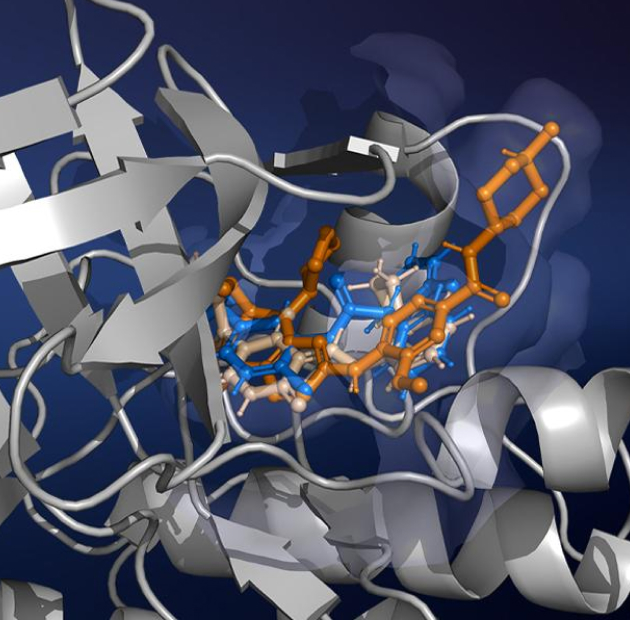
Shape Screening is a ligand-based workflow for efficiently screening ultra-large purchasable or synthesizable compound libraries. Chemically-intuitive ligand alignments are scored based on the quality of the shape overlap against a reference ligand. Shape Screening identifies potential hit molecules with activity even when they are topologically dissimilar to the known reference ligand, making it a powerful ligand-based screening method.

Access multiple Shape Screening workflows from a single access license

Quick Shape

Store and screen tens to hundreds of billions of molecules at speeds exceeding Shape GPU performance by 30% as well as reducing hard disk requirements by a factor of 100

Shape GPU

Perform GPU-accelerated high-throughput virtual screenings on millions of molecules with ~11,000 comparisons per second

Shape CPU

Screen hundreds of thousands to millions of molecules quickly on multiple CPUs

Key Capabilities

Generate intuitive and information rich, high-quality 3D alignments of common scaffolds
Identify true hits in libraries from one to over one billion compounds
Jump-start your screening with prepared compound libraries from vendors including Enamine, Mcule, Molport, WuXi, Millipore Sigma, and Sigma-Aldrich
Access multiple Shape Screening workflows from a single access license

Description of Shape Screening Workflows

Workflow Description Library Size Time to screen 4.0B (days) Time to screen 6.5B (days) Storage space for 6.5B (TB)
Quick Shape Combination of 1D-SIM* prefilter and Shape CPU Screening > 4.0 billion 5.2 5.5‡ 0.4
Shape GPU GPU-accelerated 3D screening < 5.0 billion 4.6 7.5‡ 33
Shape CPU CPU-based 3D screening < 10 million NA NA NA

QuickShape screening in the age of ultra-large libraries

Learn about QuickShape, an automated staged workflow combining both 1D and 3D approaches, which enables efficient 3D-Shape screenings for library sizes in the tens of billions of molecules.

Save compute time and effort using prepared commercial libraries for Shape Screening

Schrödinger has partnered with leading providers to help you access commercial databases of fragments, lead-like, near drug-like, and drug-like compounds ranging from millions to billions of compounds encompassing a vast chemical space.

MCule
PWuXi-AppTec
Sigma-Aldrich
MolPort
Enamine

Documentation & Tutorials

Get answers to common questions and learn best practices for using Schrödinger’s software.

Life Science Documentation

Shape Screening

A ligand-based workflow for efficiently screening ultra-large purchasable or synthesizable compound libraries.

Life Science Documentation

Learning Path: Virtual Screening

A structured overview of how to construct a virtual screening pipeline.

Life Science Tutorial

Ligand-based Screening for Ultra-Large Libraries with Quick Shape and the Hit Analyzer

Perform a Quick Shape screening on a library of 20000 compounds and analyze the results.

Life Science Tutorial

Rapid Screening of Chemical Libraries with GPU Shape

Perform rapid shape-based screening of a 20,000 compound chemical library with GPU Shape.

Related Products

Learn more about the related computational technologies available to progress your research projects.

Phase

An easy-to-use pharmacophore modeling solution for ligand- and structure-based drug design

ConfGen

Accurate and efficient conformational search solution

Prepared Commercial Libraries

Fully prepared databases of purchasable compounds

Publications

Browse the list of peer-reviewed publications using Schrödinger technology in related application areas.

Life Science Publication

Shape-Based Virtual Screening of a Billion-Compound Library Identifies Mycobacterial Lipoamide Dehydrogenase Inhibitors

Life Science Publication

Exploring Conformational Search Protocols for Ligand-based Virtual Screening and 3-D QSAR Modeling

Life Science Publication

Boosting virtual screening enrichments with data fusion: Coalescing hits from two-dimensional fingerprints, shape, and docking

Life Science Publication

Structure-based virtual screening of MT2 melatonin receptor: Influence of template choice and structural refinement

Training & Resources

Online certification courses

Level up your skill set with hands-on, online molecular modeling courses. These self-paced courses cover a range of scientific topics and include access to Schrödinger software and support.

Tutorials

Learn how to deploy the technology and best practices of Schrödinger software for your project success. Find training resources, tutorials, quick start guides, videos, and more.

Modeling Services

background pattern

Modeling Services

Services for target enablement, hit discovery, ADMET liabilities, and crystal structure prediction

Propel your drug discovery program with unrivaled technologies and expertise

Access Schrödinger’s latest technologies, run at scale

Benefit from the expertise of our team of computational scientists

All licensing, computing, and service time included

Schrödinger’s latest technologies at scale, in the hands of our team of computational experts

Target Enablement Services

Unlock your program for rigorous structure-based design

Let us help you prepare your protein target of interest for prospective FEP+ free energy calculations. Start from experimental x-ray structures, or incomplete cryoEM or AlphaFold structures, with known SAR. Schrödinger scientists leverage our unique technologies and expertise to model and validate protein-ligand complexes for highly predictive structure-based design methods.

Hit Discovery Services

Find more diverse hits, faster with advanced virtual screening technologies

Kickstart your drug discovery program with extensively validated virtual screening and rescoring workflows that leverage Schrödinger’s latest technologies at scale. Screen commercial libraries >5 billion compounds (or >300 million for fragment screens) using both structure- and ligand-based approaches simultaneously, followed by unique rescoring technologies with unrivaled accuracy. Identify more and better potent hits while purchasing and testing fewer compounds.

De Novo Design Services

Rapidly generate and prioritize novel design ideas that meet project-specific criteria

Accelerate and increase the chance of success for your hit-to-lead or lead optimization efforts with our unique ultra-large scale chemical exploration technologies. Starting from a hit molecule or lead series, we’ll help you identify synthetically tractable molecules that meet key project criteria (e.g. on-target potency) by combining multiple compound enumeration strategies with an advanced filtering cascade and rigorous potency scoring with free energy calculations.

Structure-Based ADMET Services

De-risk ADMET liabilities more efficiently using structure-based design

Resolve CYP3A4, CYP2D6, hERG, and PXR hurdles early to advance your drug discovery program. We’ll help de-risk off-target liabilities by enabling FEP+ for common ADMET anti-targets, using a rigorous, structure-based approach powered by Schrödinger’s technology and expertise.

Crystal Structure Prediction Services

De-risk your solid form selection process by identifying the most stable polymorph at RT

Overcome the risks associated with disappearing polymorphs in late stage drug development. For a given active pharmaceutical ingredient (API), we will leverage our proprietary crystal structure prediction (CSP) platform to identify the most stable crystal polymorph at room temperature. Starting from a 2D structure of the API, we deliver to you the thermodynamic stability ranking of crystal polymorphs.

Protein Design Services

Optimize your protein design projects with structure-based modeling

Bridge the gap between traditional wet lab approaches and in silico protein optimization with Schrödinger’s Protein Design Services. Schrödinger scientists will leverage our expertise and unique computationally-driven protein mutation workflow which integrates our differentiated technologies, including FEP+, to propel your discovery program.

Training & Resources

Online certification courses

Level up your skill set with hands-on, online molecular modeling courses. These self-paced courses cover a range of scientific topics and include access to Schrödinger software and support.

Tutorials

Learn how to deploy the technology and best practices of Schrödinger software for your project success. Find training resources, tutorials, quick start guides, videos, and more.

QSite

QSite

A high-performance QM/MM program

QSite

Overview

QSite is a multi-scale simulation tool that utilizes the QM/MM method, which combines the principles of quantum mechanics and molecular mechanics. It is designed to accurately predict the molecular configurations, energetics, and the electronic structures of a reactive system through quantum chemical treatment of atoms, providing crucial insights into reactive chemistry essential for understanding chemical transformation in the presence of intermolecular interactions. QSite is equally applicable for describing non-reacting chemical systems.

Key Capabilities

High performance

Outperforms other QM/MM programs because it takes advantage of Jaguar, long recognized as the industry leader in QM calculations.

Advanced technology

Provides an innovative approach to the QM/MM interface specifically addressing protein systems and interactions between QM and MM regions.

Transition metal convergence

Achieves a high degree of accuracy in metalloproteins thanks to Jaguar’s advanced capabilities; it reliably and efficiently converges to the correct ground state of transition metal containing systems.

Wavefunction choices

Offers different levels of theory to evaluate the QM region: Hartree Fock, DFT, and local MP2. This allows the user to choose the best balance between computational cost and accuracy.

Advanced calculation setup and analysis

Automatically applies special interface parameters, making it simple to set up calculations. Computed results, such as molecular orbitals and electron densities, can be visualized within Maestro.

Documentation & Tutorials

Get answers to common questions and learn best practices for using Schrödinger’s software.

Life Science Documentation

QSite

A multi-scale simulation tool that utilizes the QM/MM method, which combines the principles of quantum mechanics and molecular mechanics.

Life Science Tutorial

Defining QM and MM regions in QSite

Define regions to treat with QM and with MM for a QSite calculation.

Related Products

Learn more about the related computational technologies available to progress your research projects.

FEP+

High-performance free energy calculations for drug discovery

Jaguar

Quantum mechanics solution for rapid and accurate prediction of molecular structures and properties

Maestro

Complete modeling environment for your molecular discovery

MS Mobility

Atomistic simulation and analysis of charge mobility in solid-state films of organic semiconductors

Publications

Browse the list of peer-reviewed publications using Schrödinger technology in related application areas.

Materials Science Publication

Sub-micro- and nano-sized polyethylene terephthalate deconstruction with engineered protein nanopores

Life Science Publication

Light Harvesting by Equally Contributing Mechanisms in a Photosynthetic Antenna Protein

Life Science Publication

Mechanistic and Computational Studies of the Reductive Half-Reaction of Tyrosine to Phenylalanine Active Site Variants of d-Arginine Dehydrogenase

Life Science Publication

Water in the active site of ketosteroid isomerase

Life Science Publication

Insights into the different dioxygen activation pathways of methane and toluene monooxygenase hydroxylases

Life Science Publication

Carbon Monoxide Dehydrogenase Reaction Mechanism: A Likely Case of Abnormal CO2 Insertion to a Ni-H- Bond

Life Science Publication

Unexpected electron transfer mechanism upon AdoMet cleavage in radical SAM proteins

Life Science Publication

Lead identification of acetylcholinesterase inhibitors-histamine H3 receptor antagonists from molecular modeling

Life Science Publication

Structure-guided discovery of cyclin-dependent kinase inhibitors

Life Science Publication

Intermediates in dioxygen activation by methane monooxygenase: a QM/MM study

Training & Resources

Online certification courses

Level up your skill set with hands-on, online molecular modeling courses. These self-paced courses cover a range of scientific topics and include access to Schrödinger software and support.

Tutorials

Learn how to deploy the technology and best practices of Schrödinger software for your project success. Find training resources, tutorials, quick start guides, videos, and more.

QikProp

background pattern

QikProp

Rapid ADME predictions of drug candidates

Enhancing drug development with ADME properties prediction

QikProp is an advanced tool for predicting pharmacokinetic and physicochemical (ADME) properties of small organic molecules based on the full 3D molecular structure.

Approximately 40% of drug candidates fail in clinical trials due to poor ADME (absorption, distribution, metabolism, and excretion) properties, leading to soaring development costs. Early detection of problematic candidates can significantly reduce wasted time and resources.

Accurate ADME prediction, prior to costly experimental procedures like HTS, eliminates unnecessary testing on destined-to-fail compounds. It also refines lead optimization efforts, improving desired compound properties. Incorporating ADME predictions into development generates lead compounds with significantly  higher chances of success in clinical trials.

Key Capabilities

Wide range of predicted properties

Predicts the widest variety of pharmaceutically relevant properties – octanol/water and water/gas log Ps, log S, log BB, overall CNS activity, Caco-2 and MDCK cell permeabilities, log Khsa for human serum albumin binding, and log IC50 for HERG K+-channel blockage – so that decisions about a molecule’s suitability can be made based on a thorough analysis.

Accurate ADME properties

Provides equally accurate results in predicting properties for molecules with novel scaffolds as for analogs of well-known drugs.

Exploring better hits

Rapidly screens compound libraries for hits and filters out candidates with unsuitable ADME properties, identifying and prioritizing the most promising ones. 

Improving accuracy

Computes over twenty physical descriptors, which can be used to improve predictions by fitting to additional or proprietary experimental data, and to generate alternate QSAR models.

Documentation & Tutorials

Get answers to common questions and learn best practices for using Schrödinger’s software.

Life Science Documentation

QikProp

An advanced tool for predicting pharmacokinetic and physicochemical (ADME) properties of small organic molecules based on the full 3D molecular structure.

Related Products

Learn more about the related computational technologies available to progress your research projects.

FEP+

High-performance free energy calculations for drug discovery

Publications

Browse the list of peer-reviewed publications using Schrödinger technology in related application areas.

Life Science Publication

Intense bitterness of molecules: Machine learning for expediting drug discovery

Materials Science Publication

Bitter or not? BitterPredict, a tool for predicting taste from chemical structure

Life Science Publication

Discovery of Thienoquinolone Derivatives as Selective and ATP Non-Competitive CDK5/p25 Inhibitors by Structure-Based Virtual Screening

Life Science Publication

A Structure-Based Model for Predicting Serum Albumin Binding

Life Science Publication

Search for Non-Nucleoside Inhibitors of HIV-1 Reverse Transcriptase Using Chemical Similarity, Molecular Docking, and MM-GB/SA Scoring

Life Science Publication

Dihydropyridopyrazinones and Dihydropteridinones as Corticotropin-Releasing Factor-1 Receptor Antagonists: Structure-Activity Relationships and Computational Modeling

Life Science Publication

Solution-Phase Synthesis of a Tricyclic Pyrrole-2-Carboxamide Discovery Library Applying a Stetter-Paal-Knorr Reaction Sequence

Life Science Publication

Computer-Aided Design of Non-Nucleoside Inhibitors of HIV-1 Reverse Transcriptase

Life Science Publication

Influence of Molecular Flexibility and Polar Surface Area Metrics on Oral Bioavailability in the Rat

Life Science Publication

QSAR Studies of PC-3 Cell Line Inhibition Activity of TSA and SAHA-like Hydroxamic Acids

Training & Resources

Online certification courses

Level up your skill set with hands-on, online molecular modeling courses. These self-paced courses cover a range of scientific topics and include access to Schrödinger software and support.

Tutorials

Learn how to deploy the technology and best practices of Schrödinger software for your project success. Find training resources, tutorials, quick start guides, videos, and more.

PrimeX

PrimeX

A comprehensive package for accurate protein crystal structure refinement

PrimeX

Overview

PrimeX is an advanced tool to facilitate protein crystal structure refinement and produces accurate structures more compatible with computational chemistry applications than those produced by other protein refinement programs.

Traditional protein crystallography introduces issues for downstream modeling due to high-energy contacts and missing hydrogens. PrimeX addresses these concerns by restraining protein geometry to OPLS-AA, adding hydrogens during refinement, and improving non-bonded interactions for better structure accuracy.

Key Capabilities

Loop building and refinement

Builds loops up to 40-residues in length, using technologies in the well-validated Prime protein modeling program and guided by electron density fit.

Ligand placement

Places ligands and other small molecules into electron density using technologies in the Glide docking program, which has demonstrated superior accuracy in ligand-receptor docking.

Accurate all-atom force field

Utilizes the OPLS-AA force field with state-of-the-art computational technologies to refine protein structures that are immediately ready for all computational simulations.

Advanced refinement techniques

Provides simulated annealing for reciprocal space refinement.

Choice of minimizers

Offers conjugate gradient, truncated Newton, and quasi-Newton (LBFGS) to optimize performance and accuracy.

Automatic parameter generation

Generates parameters for ligands and other small molecules, as well as modified residues, automatically without requiring user intervention.

Treatment of hydrogens

Automatically adds hydrogens, which are included during refinement according to physical chemistry as prescribed by the OPLS-AA force field.

Easy to use

Intuitive user interface is integrated into Maestro with step-by-step organization of refinement statistics in the Project Table and convenient analysis of protein structure geometry through interactive tables and plots.

Advanced calculation controls

Allows command-line input as well as scripting with Python for added control and customizable operations.

Documentation & Tutorials

Get answers to common questions and learn best practices for using Schrödinger’s software.

Life Science Documentation

PrimeX

An advanced tool to facilitate protein crystal structure refinement and produces accurate structures more compatible with computational chemistry applications than those produced by other protein refinement programs.

Related products

Learn more about the related computational technologies available to progress your research projects.

Prime

A powerful and innovative solution for accurate protein structure prediction

Glide

Industry-leading ligand-receptor docking solution

Publications

Browse the list of peer-reviewed publications using Schrödinger technology in related application areas.

Life Science Publication

Investigating Protein-Peptide Interactions Using the Schr’dinger Computational Suite

Life Science Publication

Structure of the Arabidopsis thaliana TOP2 oligopeptidase

Life Science Publication

A Structure-Based Model for Predicting Serum Albumin Binding

Life Science Publication

Allosteric Inhibition of the NS2B-NS3 Protease from Dengue Virus

Life Science Publication

Significant reduction in errors associated with non-bonded contacts in protein crystal structures: Automated all-atom refinement with PrimeX

Life Science Publication

PrimeX and the Schrödinger computational chemistry suite of programs

Life Science Publication

The crystal structure of DehI reveals a new ‘-haloacid dehalogenase fold and active-site mechanism

Training & Resources

Online Certification Courses

Level up your skill set with hands-on, online molecular modeling courses. These self-paced courses cover a range of scientific topics and include access to Schrödinger software and support.

Tutorials

Learn how to deploy the technology and best practices of Schrödinger software for your project success. Find training resources, tutorials, quick start guides, videos, and more.

Prepared Commercial Libraries

background pattern

Prepared Commercial Libraries

Jump-start your virtual screens with prepared databases of commercially available small molecules

Save compute time and effort using pre-prepared databases for immediate deployment with a variety of structure-based and ligand-based virtual screening technologies including Glide, Active Learning Glide, Phase, Shape-GPU, and QuickShape. Schrödinger has partnered with Enamine, MilliporeSigma, MolPort, WuXi, and Mcule to provide databases of fragments, lead-like, near drug-like, and drug-like compounds ranging from millions to billions of compounds encompassing a vast chemical space.

MCule
PWuXi-AppTec
Sigma-Aldrich
MolPort
Enamine

Ready inputs for ligand- and structure-based hit discovery

Large commercial libraries (up to 10 million compounds)

Ultra-large libraries (up to 6.5 billion compounds)

  • Enamine REAL
  • WuXi LabNetwork
  • Mcule Ultimate

Diverse screening technologies and compatible libraries

Phase Shape QuickShape Glide Active Learning Glide
Enamine Screening
Millipore Sigma
MolPort
Mcule Screening
Enamine REAL
WuXi  ✔  ✔
Mcule Ultimate  ✔  ✔

Case studies & webinars

Discover how Schrödinger technology is being used to solve real-world research challenges.

Life Science Webinar

Modern Virtual Screening Technologies 利用薛定谔数字化平台进行现代虚拟筛选

Life Science White Paper

Dramatically improving hit rates with a modern virtual screening workflow

Life Science Webinar

Expect Success: Modern Virtual Screening Technologies that Actually Deliver High-Quality, Developable Hits

In this webinar, we describe several recent case studies from the Schrödinger Therapeutics Group where this modern large-scale virtual screening workflow resulted in double-digit hit rates across a diverse range of targets.

Life Science White Paper

Benchmark study of DeepAutoQSAR, ChemProp, and DeepPurpose on the ADMET subset of the Therapeutic Data Commons

Life Science Webinar

Active Learning Glide – Screen Billions of Compounds Efficiently and Cost Effectively

In this webinar, we illustrate how using an Active Learning approach combined with Glide enables cost effective and accurate screening of billion compound libraries.

Related Products

Learn more about the related computational technologies available to progress your research projects.

Glide

Industry-leading ligand-receptor docking solution

Phase

An easy-to-use pharmacophore modeling solution for ligand- and structure-based drug design

Shape Screening

Efficient ligand-based virtual screening of millions to billions of molecules

Active Learning Applications

Accelerate discovery with machine learning

Virtual Screening Web Service

Virtual, novel hits from a billion-compound library delivered in one week

Publications

Browse the list of peer-reviewed publications using Schrödinger technology in related application areas.

Life Science Publication

Shape-Based Virtual Screening of a Billion-Compound Library Identifies Mycobacterial Lipoamide Dehydrogenase Inhibitors

Training & Resources

Online certification courses

Level up your skill set with hands-on, online molecular modeling courses. These self-paced courses cover a range of scientific topics and include access to Schrödinger software and support.

Tutorials

Learn how to deploy the technology and best practices of Schrödinger software for your project success. Find training resources, tutorials, quick start guides, videos, and more.

Phase

Phase

Easy-to-use pharmacophore modeling solution for ligand- and structure-based drug design

Create and validate pharmacophore hypotheses

Identify novel hits with pharmacophore screening

Phase is an intuitive pharmacophore modeling tool that allows assessment of compounds based on the steric and electronic features of molecules known to have biological activity. Phase employs a unique common pharmacophore perception algorithm designed for use in both lead optimization and virtual screening, and helps create understanding of an unknown binding site in the absence of a protein structure.

Key Capabilities

Easily setup, execute, and analyze pharmacophore screening with an intuitive user interface
Screen and determine the spatial arrangement of chemical features that interact with a receptor and use the binding information to better identify novel compounds and chemotypes that are likely to bind to the target receptor
Create hypotheses from protein-ligand complexes, apo proteins, or from ligands and selectively merge hypotheses features to create hybrid models 
Exercise precise control over pharmacophore creation, generation and screening
Rapidly and thoroughly sample conformational, ionization, and tautomeric states, with optional minimization using the best-in-class OPLS4 force field to create a phase database 
Benefit from fully prepared databases of purchasable compounds from Enamine, MilliporeSigma, MolPort and Mcule for out-of-the-box screening

Save compute time and effort using prepared commercial libraries for Phase

Schrödinger has partnered with leading providers to help you access commercial databases of fragments, lead-like, near drug-like, and drug-like compounds ranging from millions to billions of compounds encompassing a vast chemical space.

MCule
PWuXi-AppTec
Sigma-Aldrich
MolPort
Enamine
Case StudyCase-study_Nimbus-ACC

Discovery of a novel, potent ACC inhibitor driven by computationally-guided design and assessment of water energetics in the binding site

See how Nimbus identified potent, selective inhibitors using a virtual screening workflow guided by hydration energetics.

read the case study

Documentation & Tutorials

Get answers to common questions and learn best practices for using Schrödinger’s software.

Life Science Documentation

Phase

An intuitive pharmacophore modeling tool that allows assessment of compounds based on the steric and electronic features of molecules known to have biological activity.

Life Science Tutorial

Ligand-based Screening for Ultra-Large Libraries with Quick Shape and the Hit Analyzer

Perform a Quick Shape screening on a library of 20000 compounds and analyze the results.

Life Science Tutorial

Ligand-Based Virtual Screening Using Phase

Create and analyze pharmacophore hypotheses from congeneric and diverse ligand sets.

Life Science Tutorial

Structure-Based Virtual Screening Using Phase

Create and analyze pharmacophore models generated from a protein-ligand complex.

Life Science Tutorial

Rapid Screening of Chemical Libraries with GPU Shape

Perform rapid shape-based screening of a 20,000 compound chemical library with GPU Shape.

Related Products

Learn more about the related computational technologies available to progress your research projects.

Shape Screening

Efficient ligand-based virtual screening of millions to billions of molecules

Glide

Industry-leading ligand-receptor docking solution

Epik

Rapid pKa and protonation state prediction tool

ConfGen

Accurate and efficient conformational search solution

Publications

Browse the list of peer-reviewed publications using Schrödinger technology in related application areas.

Life Science Publication

ePharmaLib: A Versatile Library of e-Pharmacophores to Address Small-Molecule (Poly-)Pharmacology

Life Science Publication

A Comprehensive Ligand Based Mapping of the ‘2 Receptor Binding Pocket

Life Science Publication

Computational Tool for Fast In silico Evaluation of hERG K+ Channel Affinity

Life Science Publication

Identification of Novel Fluorescent Probes Preventing PrPSc Replication in Prion Diseases

Life Science Publication

Discovery and Structure Activity Relationships of a Highly Selective Butyrylcholinesterase Inhibitor by Structure-Based Virtual Screening

Life Science Publication

Exploring Clotrimazole-based Pharmacophore: 3D-QSAR Studies and Synthesis of Novel Antiplasmodial Agents

Life Science Publication

Discovery of Thienoquinolone Derivatives as Selective and ATP Non-Competitive CDK5/p25 Inhibitors by Structure-Based Virtual Screening

Life Science Publication

Optimization, Pharmacophore Modeling and 3D-QSAR Studies of Sipholanes as Breast Cancer Migration and Proliferation Inhibitors

Life Science Publication

Multiple e-pharmacophore modeling combined with high-throughput virtual screening and docking to identify potential inhibitors of ‘-Secretase(BACE1)

Life Science Publication

IDSite: An Accurate Approach to Predict P450-Mediated Drug Metabolism

Training & Resources

Online certification courses

Level up your skill set with hands-on, online molecular modeling courses. These self-paced courses cover a range of scientific topics and include access to Schrödinger software and support.

Tutorials

Learn how to deploy the technology and best practices of Schrödinger software for your project success. Find training resources, tutorials, quick start guides, videos, and more.